All I wanted to know was how the NYC government works and now I’m insufferable at parties.
Around 90% of people arrested in NYC are released after their arraignment. After a person is arrested, they must be brought in front of a judge to have their bail set prior to their court date. The purpose of bail is to prevent someone from escaping before they have a chance to go to trial. It’s worth remembering that, at this point, the person hasn’t been convicted of anything — they’re presumed innocent and have only been accused of a crime. Historically speaking, most bail was set using money. The judge sets a sum of money that the defendant must pay to be released prior to the court date — this is then held as a deposit, which is returned after the court case finishes. The alternative is that you are jailed, which in NYC means an average stay of 104 days before your trial begins.
New York State reformed their bail system in 2019. The main thrust of the reform was to remove cash bail. Since 2019, the legislature has walked back parts of the reform through three rounds of amendments, which allowed bail for various violent crimes, felonies committed while on probation or parole, repeat offenses involving harm to people or property. The 2023 changes removed the “least restrictive means” standard, giving judges broader discretion to ensure defendants returned to court.
The idea was that having cash bail led to bad outcomes, because if you were poor you were more likely to be disproportionately affected by cash bail. The amount of time the money would have to be surrendered was a massive barrier for poorer accused. Whereas if you were wealthy, despite the magnitude of the crime, you’d be more likely to go free and continue with your life since high bail amounts wouldn’t be a barrier to release. There were other reasons to remove cash bail — the success of a program which supervises people released by the court run by the Criminal Justice Agency, as well as the overflowing Rikers Island and the desire to shut it down.
The court generally has four options when setting bail. A person can be released (ROR), released with non-monetary conditions, monetary bail, or jailed (CPL § 510.10(4)). Release with non-monetary conditions includes travel restrictions, orders of protection (restraining orders), and supervised release.
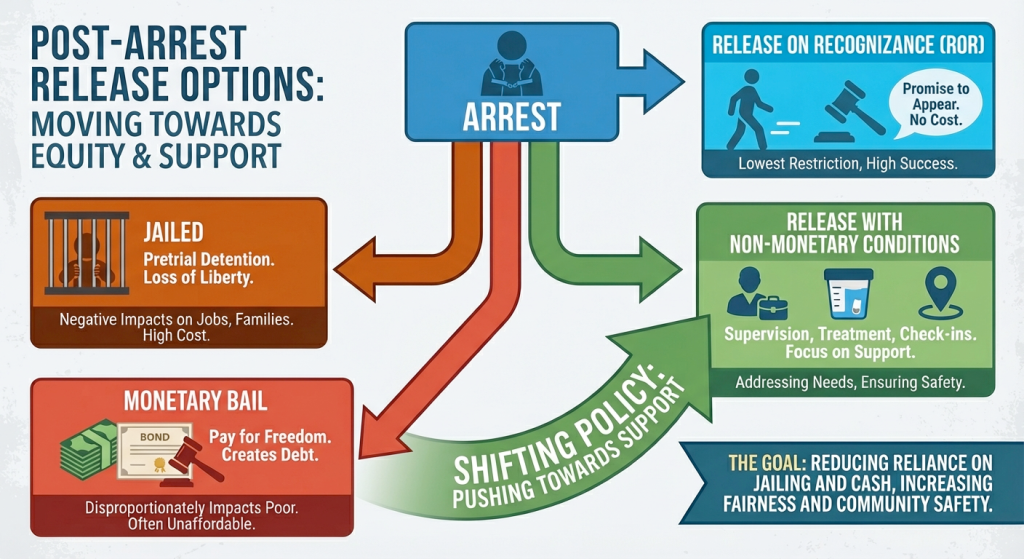
I’ve thought about this for a long time and I have some thoughts about where this works well and where it doesn’t. Also, it’s a tricky topic and it’s tough to put in nuanced terms, I’m doing my best! I’ve been to arraignments a few times now in the NY County Criminal Courthouse at 100 Centre St — they run court after 5PM there. I recommend showing up, the sessions are open to the public.
My perspective in this post is that the supervised release program is a complete win! I’m extremely glad that NYC has implemented a fairer, cheaper, more just system that’s just entirely better than what came before it. At a high level, I’m a strong supporter of the supervised release system, but also have some thoughts that I haven’t really seen before. Also, disclaimers — I’m not a lawyer and my knowledge of this extends only to NYC and not NY state.
A lot of advantages with minimal downsides
Supervised release offers many advantages over monetary bail. Most importantly, it works just as well in terms of overall outcomes — New York City’s failure-to-appear rate actually decreased from 15% in 2019 to 9% in 2021. A drop in the failure-to-appear rate is surprising, since we started releasing more people! Beyond effectiveness, supervised release reduces costs to the city (where the average cost per jailed inmate is $208,513 per year!), minimizes disruption to the accused’s life, and creates opportunities for targeted interventions through social programs that address underlying issues. The approach also improves racial equity while being more effective. This is everything I want to see — cheaper, better, more fair.
Supervised release isn’t all positive. The MDRC evaluation found that 44% of supervised release enrollees would likely have been released on their own recognizance if the program didn’t exist, suggesting it may be widening the net on who is enrolled in the program. This means that before supervised release, judges would have let certain people go free, but now are being put into supervised release. This implies that judges may end up overusing it on people who would have returned to court by themselves. The program can also burden accused individuals who struggle to meet requirements and it’s politically vulnerable to funding cuts that could reduce it to pro forma box-checking. Critics also raise concerns about increased crime from releasing individuals who would otherwise have been detained.
Overall, I’d characterize the advantages as vastly outweighing the negatives. The fundamental argument for supervised release rests on a straightforward principle: jailing someone for a less serious crime simply because they lack bail money is net negative, potentially generating more criminality in the long run than allowing them to continue with their lives under supervision — especially now that exceptions exist for no-bail policies for major crimes, ensuring those who genuinely need to be detained still can be.
Criminal Justice Agency is the non-profit that provides pretrial risk assessments, release recommendations, and runs supervised release. CJA has been fantastic! Their programs are cheaper than jail and more fair. Innocent people can continue with their life, and not enter a doom spiral. Check out this webinar about how well it works!
The idea behind the supervised release program is that many people can be trusted to return to the court day with a certain level of support. There are different tiers of supervised release, such as: a single monthly phone check-in, weekly in-person reporting, mental health treatment, or outpatient addiction treatment. The benefit of this is that by using data in a smart way, they can predict the likelihood of someone returning to court, and thus tailor the tier of supervision that person is likely to require. This works surprisingly well and has had massive effects in making New York’s judicial system much more fair and cost-effective while improving outcomes in terms of people appearing for their court dates.
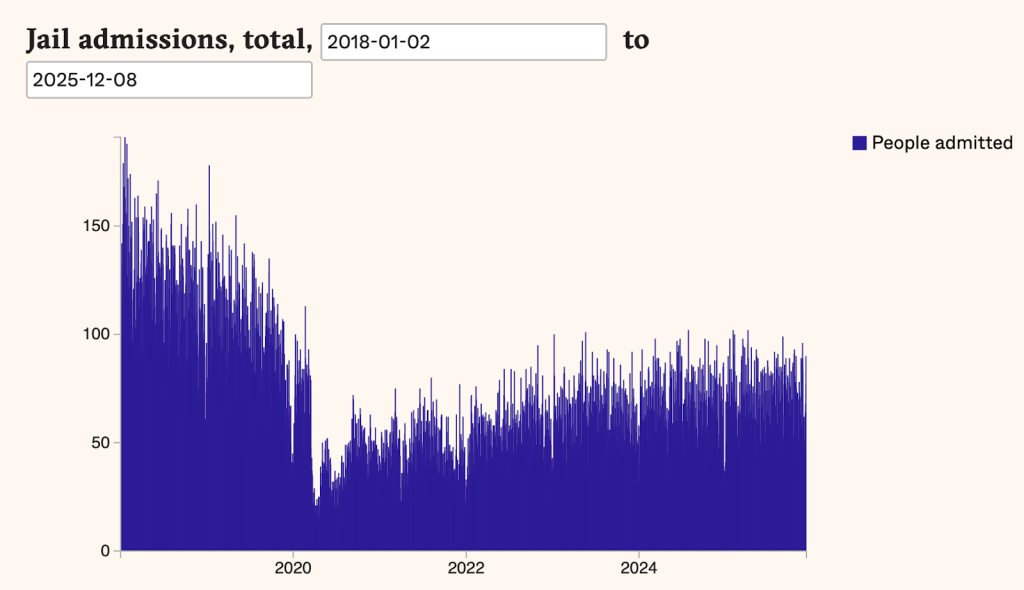
Figure from Vera Institute, showing the drop in jail admissions — cashless bail was instituted in January 2020
CJA also has a scoring system to determine how likely a person is to return to court — which has been developed through the data collected from running supervised release. This is something that the judges and assistant district attorneys rely on in order to determine whether a person should be released without cash bail and onto the street on supervised release. I want to reiterate that this works really, really well.
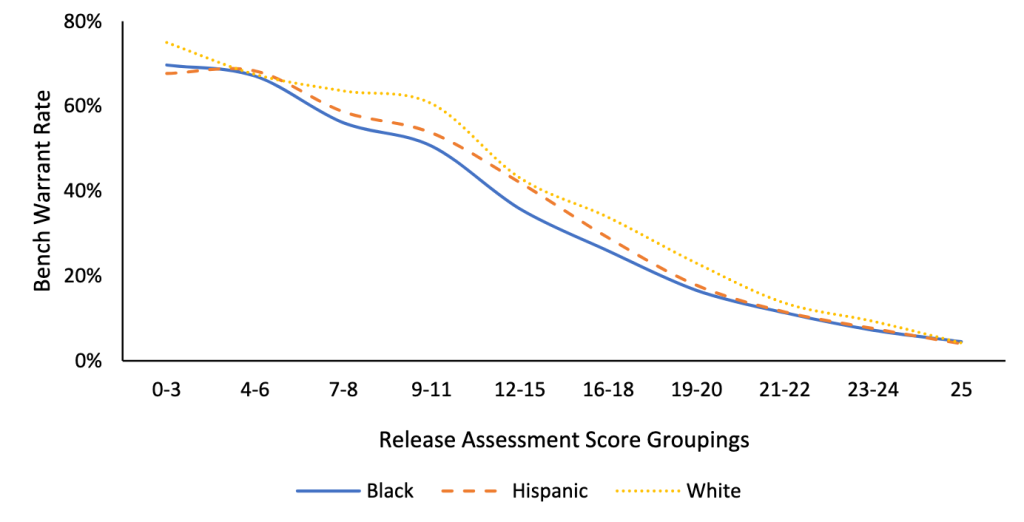
The above figure demonstrates that low (bad) release scores accurately predict failure to appear for court — across racial groups.
The CJA risk assessment considers factors like how many times the accused has failed to appear for court, recent criminal convictions, and number of pending cases. The assessment also considers community ties, measured by factors such as years spent living at the last two addresses and whether they can be reached by phone.
NYC isn’t the first jurisdiction to implement cashless bail. Washington DC implemented it in the 90’s, followed by New Mexico, Illinois, and New Jersey, among others. What NYC has done by reducing the usage of monetary bail is part of a wider trend. Internationally, monetary bail is rare — the US & the Philippines are the only countries with for-profit bail systems. Cash bail is generally rarely used.
Overall results inside the US have been good — meaning that reducing cash bail has not spiked crime. This may have been the case within New York City as well, where increasing the use of non-monetary bail may have not materially changed the amount of crime. I’m hedging since this is controversial and I found various studies showing that bail reform did or did not contribute to the post-2020 crime waves in cities. Overall consensus seems to be that bail reform had a minor effect compared to the COVID related changes and my gut agrees.
New York State after the 2019 reform had multiple changes to bail reform, in 2020, 2022, and 2023 that rolled back some of the measures to reduce the use of monetary bail. Speaking generally, the changes post-2019 re-allowed the use of monetary bail for violent crimes and felonies. These changes happened relatively quickly and prevented some of the more egregious problems that could arise during the implementation of cashless bail.
What happens when someone fails supervised release? Staff first attempt to re-engage the participant and alert the court. For persistent noncompliance like willfully failing to appear, committing a new felony, or violating a restraining order — courts can revoke release conditions and set new ones, including bail or detention, after a hearing.
But dangerous people get released too…
New York State has not enforced a standard of dangerousness on people being released on bail since 1971. The only characteristic that is taken into consideration when releasing someone on bail rather than jailing them is whether they are likely to return to court or not. This means that if a person is considered dangerous or likely to re-offend, this is explicitly not something the judge could take into account when setting bail conditions or release conditions. New York State is alone in this — every one of the other 49 states has a dangerousness standard.
This has put judges in a difficult position. Bronx Criminal Court Judge Jeffrey Zimmerman describes the current statute as “a confusing mess.” The Legislature, he argues, is trying to have it both ways, with each round of amendments since 2019 adding more dangerousness-related factors to the bail statute — prior firearm use, whether the charge causes harm, crimes committed — while still officially maintaining that bail’s only purpose is ensuring return to court. The “harm on harm” provision, which allows bail when someone commits a harm crime while released on another harm charge, sounds tough but is narrow in practice. It doesn’t apply if the first case is resolved before the second arrest, or if the charges don’t both qualify as “harm,” leaving judges unable to act on obvious patterns of escalation. Judges are required to consider factors that obviously relate to dangerousness, but are forbidden from using them for that purpose. The only way to make the statute internally consistent, Zimmerman writes, is to conclude that the Legislature is implicitly telling judges that dangerous people are less likely to return to court. Nobody actually believes that’s the real concern, but it’s the only legal fiction that makes the statute coherent.
Previously, this wasn’t a big issue primarily because of the existence of cash bail. When cash bail existed, the issue of dangerousness was obscured by the fact that many of the people that would have otherwise been released were lacking the stability or resources to afford cash bail and hence were jailed regardless. The 2019 bail reforms revealed a pre-existing issue that was being obscured by the existence of cash bail and the interaction with the population of people who commit minor crimes consistently, but nothing big enough to be jailed over.
One concrete example that I saw was one person who had been meeting court dates but was currently accused, on separate occasions, of burglary, attempted murder, possession of drugs, and possession of an unlicensed firearm. Since he had been meeting court dates, the judge was forced to release him yet again — despite the judge himself saying out loud to the courtroom that he had no doubt that the defendant would once again soon be accused of a crime. This feels bad to me — everyone knows this accused will reoffend, and yet is released regardless.
Frequently, these people do not commit crimes that are bad enough to be held before trial or are imprisoned for such long periods of time as to reduce their presence on the street. This means that frequently they are cycling in and out of the criminal justice system. You can see the effects of this on the profiles of the various subway pushers in New York City. Many of them have dozens of priors and a history of assaults that have simply escalated to the point where they have pushed someone onto the subway tracks. 70% of subway violent offenders had a prior arrest for violent crime during the prior six years. Despite them likely having open court cases, they’ve been released to the supervised release program.
With all of this said, supervised release is a contentious topic — there are calls to return to monetary bail for the sake of looking tough on crime. Overall, I think cashless bail is promising and the best route to protecting it and improving it is to gather more data.
The data we’d need to settle this question doesn’t really exist — at least not publicly. The main source we have on this is from the NYPD — which regardless of veracity should be confirmed due to potential for conflict of interest. CJA already collects data on reoffenses, it’d be wonderful if this would be made public to better understand the nature of the issue. A bill in the State Senate recently failed to make it out of committee — one potential reason is that statewide data collection on this scale may be simply unavailable. CJA is in the unique position of having comprehensive data collection in NYC. It’s a very long road to getting this changed. My hope is that this blog post can inspire you to take a more active stance in supporting it in informal conversations.