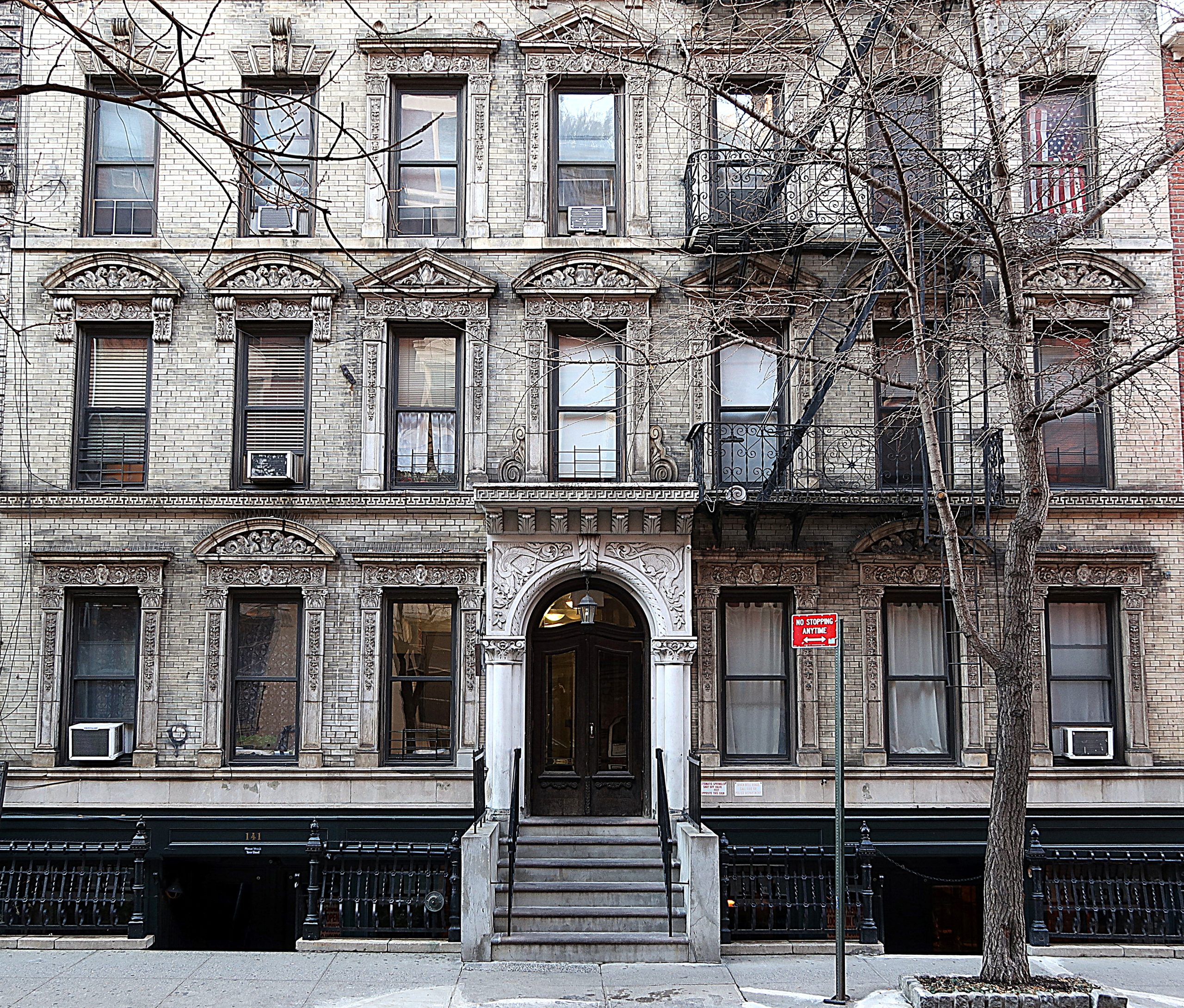
So you have a plot of land in New York. You want to put an apartment building on it. What does it look like to actually accomplish this?
A pretty usual New York City plot of land that you would put an apartment building on is 25 feet by 100 feet. This is pretty common in brownstone Brooklyn and parts of Manhattan. Let’s say this is what you inherited and you own it free and clear.
Considering we’re in a housing emergency, I’d say that it’s essential that such a standard piece of land be easily turned into new housing. In an ideal world, it’d be easy to construct some new apartment units for people to live in.
Unfortunately, due to the weight of regulations, which individually can be defensible or even crucial, this apartment building that you’d like to construct won’t pencil out.
Let’s walk through why it matters. It’s worth saying — high housing prices are the result of supply and demand. New York has had a rental vacancy rate below 5% — the legal definition of a housing emergency — for decades. As of 2023 it was 1.4%, the lowest since 1968. If there is a profit to be made, people will seek profit. A lot of housing comes from people who seek a profit — they’d love to build housing if possible!
Here’s the number we’re going to track: $4,000/month. That’s a good assumption on what the market will pay for a new one-bedroom. It’s the rent you can realistically collect from each unit once the building is standing. We’re going to watch this $4,000 get eaten by regulations, line by line and — spoiler alert — you’ll not only not make money, but you’ll be losing $3600 a month. It’s no wonder that more housing isn’t being built here.
Design
Let’s say that your place is in Manhattan, in the East Village. This means that one of the zones that’s prevalent there is R7A. Let’s say that your plot falls under that zone. In case you’re curious, you can see what zones exist in New York City at this link. Zoning regulations explain what the city allows you to build on that plot of land.
Since you’re in an R7A zoning district—a medium-density residential zone that actually allows apartment buildings as-of-right, this means you don’t need to beg the city for permission. Much of New York doesn’t allow this. Vast swaths of the city are zoned exclusively for single-family homes, untouchable without a years-long rezoning process you have no intention of starting. This is a generous assumption — in many cases you need to do the rezoning.
Based on the zone, you’re not allowed to build as many units as you’d like. You’re limited by a concept called FAR, which stands for floor area ratio — fundamentally it’s a regulation on the level of density a lot can have. For R7A, the FAR is 4.0 — this means that since you have 2,500 square feet of land you will be able to build 10,000 square feet total for the units of the building.
FAR isn’t actually the binding constraint here — the total volume restriction is. Raising FAR wouldn’t help much. Height limits and yard requirements would cap you at roughly the same density. The deeper problem is spreading fixed costs (architect, engineers, elevator) across a handful of units. This makes building a smaller apartment unlikely.
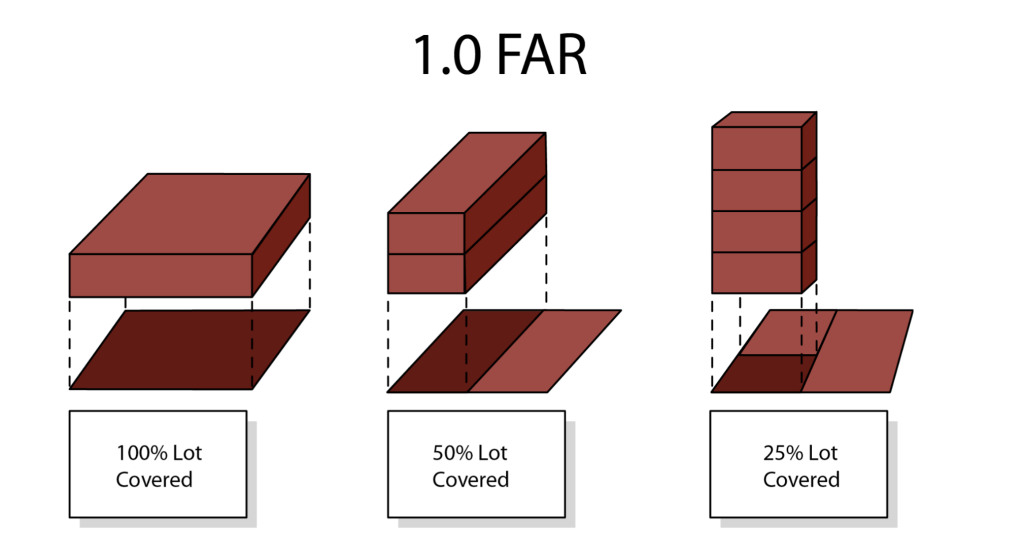
You’re limited to 85 feet high, but fortunately you won’t be going anywhere near that at 10ft per floor.
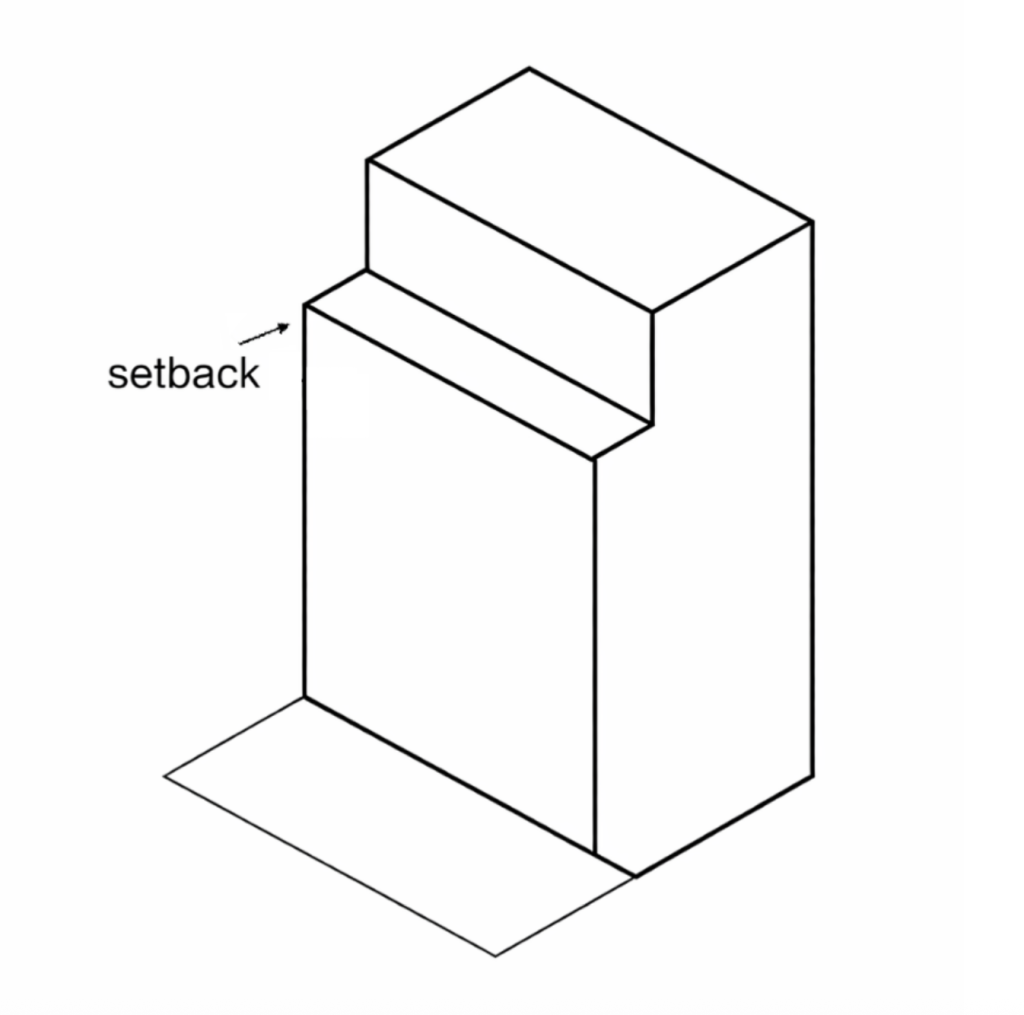
The shape of your building is also determined by the zoning regulations. You’ll need to have your wall up against the street for at least 40 to 65 feet (depending), and then you’ll be required to set your wall back at least 10 to 15 feet (also depending). This means that you can’t decide the shape of your own building — the aesthetics are set by regulation.
A small blessing, isn’t it, that parking isn’t required in this area? City of Yes recently removed parking requirements for Manhattan.
You’ll need a rear yard. Yes, I agree it’s wonderful for residents, but as Jerry Reed said, “I was gonna do what’s right, give ‘er her fair share but, boys, I didn’t know her share was gonna be that much”. Unfortunately, you’re required to give a 30 foot yard at minimum, which leaves you with 70 feet of buildable depth.
You are also required to only cover 65% of the lot, so despite the required rear yard, you’ll still need to cut down the lot coverage a touch more, so you’re at the required coverage percentage. Fortunately, you get to choose where to cut down the floor area!
Your 2,500 sq ft lot gives you 10,000 sq ft at FAR 4.0. But the 65% lot coverage cap limits your footprint to 1,625 sq ft — which on a 25-foot-wide lot means a building 65 feet deep, comfortably inside the 30-foot rear yard. Following the setback rules you get 9,375 sq ft, six stories, six units.
This means the building will be rather small — which means it’s unrealistic for New York. Fixed costs, like dealing with permits, or an elevator, mean that you can’t recoup investment at that size. The building would need to be much bigger to get built.
Six units at $4,000 each. That’s $24,000/month in gross rent against whatever it costs to get this thing built and operated. So far, the design phase has cost us nothing — we still have $4,000/unit/month to work with. Now we start spending it.
Construction
Great! You’ve got a 6 unit building in the works, so you decide to hire an architect. They inform you that since you have more than two units, you’re classified as R-2 occupancy. This triggers a cascade of requirements.
Fire-resistance-rated partitions between every unit (1 hour of fire resistance). Fire-rated corridor walls (1 hour). Fire-rated stairwell enclosures (2 hours, because you’re residential). Automatic sprinkler systems throughout, following NFPA 13 standards with New York City modifications. Fire alarm systems that require FDNY approval before installation. This all seems pretty reasonable to you. After all, fires in apartment buildings are pretty dangerous.
The sprinklers alone will cost $3–5 per square foot, assuming a NYC premium. For your roughly 9,000 square feet of actual building, that’s $27,000–$45,000 just to not burn down.
You would have been exempt from adding an elevator if you squeezed into 4 floors, but since you’re at 6 you’ll need one. That’s another $200,000 and a pile of additional code requirements.
Then there’s accessibility. Under the NYC building code, every unit with elevator access must meet “Type B+NYC” standards — which exceed federal requirements. Accessible routes through units, accessible doorways, switches within reach ranges, reinforced bathroom walls for grab bars, accessible kitchen and bathroom configurations. This is why if you live in a new construction building, your bathroom is gigantic — it’s to accommodate wheelchairs.
Oh, and as of January 2024, Local Law 154 bans natural gas in new buildings under seven stories. You’re going all-electric: heat pumps, induction cooktops, electric water heating. Your contractor hasn’t installed an all-electric building before and therefore quotes you a premium for the learning curve.
You can’t actually decide what the exterior of your building will look like — the facade you’ll choose has to pass NFPA 285 fire regulations. The energy code requirements push you towards continuous exterior foam insulation, which rules out traditional masonry and forces thin panels. This limits what you’ll be able to pick and makes it more expensive.
NYC also has specific concrete requirements that exceed national standards. Your concrete supplier will need to provide you with a NYC specific mix. You’ll need inspections for each concrete pour from a special inspection agency which files reports with the DOB.
Your electrical wiring will cost around 2x to 3x the national average. You’ll be required to use metal conduits, whereas the rest of the US makes do with plastic tubing. This not only costs more, but it takes the electrician much longer to run the conduit, bend it around corners and pull wire through it.
Hard construction lands at roughly $400/sq ft — the NYC premium. For 9,375 sq ft, that’s $3,750,000. Spread across 6 units and financed over 30 years at 7%, you need $4,160/unit/month just to service the construction debt.
About two-thirds of that $4,160 is what a merely-expensive American market would cost. The other third is the NYC code stack: the sprinklers, the elevator you needed because you have six floors, the all-electric premium, the metal conduit, the NYC concrete mix, the NFPA 285 facade, the accessible bathrooms.
Running tally:
$4,000 starting rent
−$2,775 base construction mortgage → $1,225 left
−$1,385 NYC code premiums → −$160 left
Permitting
You’ve got a plan, and your head has stopped spinning. You’ve been paying interest on your loan this entire time, by the way. Glad you’ve rested up though, because now it’s time to deal with permitting.
Your architect submits an application to the Department of Buildings. This triggers requirements for a dozen associated filings: foundation permits, plumbing permits, electrical permits, elevator permits, fire suppression permits, boiler permits. A licensed architect must seal the architectural drawings. Professional engineers must seal the structural, mechanical, electrical, plumbing, and foundation designs. You are now paying five different licensed professionals to stamp things.
Initial plan review takes six weeks. You get back a list of objections: incomplete documentation, inconsistencies between the plans and application data, missing energy code analysis. Your architect fixes them and resubmits.
Four weeks later, another round of objections.
Your architect suggests professional self-certification — licensed architects can certify that plans comply with all laws, skipping DOB review entirely. Approval happens instantly when you submit. But 20% of self-certified applications get randomly audited, potentially requiring construction modifications after you’ve already built. You decide the audit risk isn’t worth it and stick with the regular review process.
Third round of objections. Your architect fixes them. Six more weeks.
Finally, approval.
Soft costs for a project like this run ~22% of hard costs — about $825,000 for your five engineers, expediter, attorney, surveyor, insurance, DOB filing fees, and environmental reports. Plus carrying costs during construction: an 18-month build at 8% on the loan — let’s say it’ll be $300,000. Plus a 10% contingency on hard costs: $375,000.
Running tally:
−$900 soft costs (five engineers, attorney, expediter, filings) → −$1,060
−$350 carrying costs (interest on the loan during construction) → −$1,410
−$400 contingency → −$1,810
Environmental Review
It’s very lucky that you’re building as-of-right. If you needed any approval from the city — a variance, a rezoning, city funding — you’d trigger environmental review, a process that studies nineteen areas of potential impact including whether your building would cast a shadow on a park. The CEQR Technical Manual specifies that your building’s longest possible shadow is 4.3 times its height, calculated on the winter solstice. If that shadow so much as touches a playground, you need to commission a shadow study across four representative days of the year. The full process can take years and cost six figures.
Property taxes
You knew property taxes would be significant. You didn’t know they’d be this significant.
New York City’s property tax system charges apartment buildings at an effective rate roughly five times higher than single-family homes. New construction doesn’t qualify for the assessment caps that protect older small rentals, so DOF values your building by its rent roll and taxes it at the full Class 2 rate — roughly 6% of the building’s value every year. Let’s say your building will owe somewhere around $130,000 a year, or $1,800 per unit per month, just in taxes, before mortgage, maintenance, insurance, or a single dollar of income. I talked to Michael Johnson from NYAA who says my number is actually on the low end — see this comparable building here.
To recap – the median rent in Manhattan is $4,695/month. With $1,800 (or more!) gone every month for property taxes, this building could never be affordable for renters — and it’ll never even get built.
You could have avoided this by using the 485-x tax exemption (the successor to the old 421-a program). In exchange for including some affordable units, you get a property tax abatement. In certain Mandatory Inclusionary Housing zones, you don’t even have the choice—affordable units are required by law.
So technically, you could avoid the property tax! You can sign up for 485-x! Unfortunately, it doesn’t really work. The requirements of following 485-x are byzantine and would require a whole other article. In short — taking the property tax abatement would destroy your project with a dizzying array of yet more stringent requirements.
You’re as-of-right, which means that your apartment plan is pre-approved, so you skip environmental review. But the 485-x tax abatement you missed out on? That requires a discretionary approval. So if you had tried to get the tax break that makes your building financially viable, you could have triggered the environmental review that makes it financially impossible. That’s just one example of the tangle of regulations that 485-x brings with it.
Running tally:
−$1,800 property tax → −$3,610
The Bill
Let’s add it all up
| Line item | Per unit / month |
| Rent collected | $4,000 |
| Base construction mortgage | −$2,775 |
| NYC code premiums (sprinklers, elevator, all-electric, NYC concrete, metal conduit, NFPA 285 facade) | −$1,385 |
| Soft costs (five sealed engineers, attorney, expediter, DOB filings) | −$900 |
| Carrying costs (interest while you wait for stamps) | −$350 |
| Contingency | −$400 |
| Property taxes | −$1,800 |
| Net | −$3,610 |
To break even you’d need to charge roughly $7,610/month per unit and we haven’t even looked at operating costs or the cost of the land. The market will pay you $4,000. The building never gets built.
Conclusion
This level of regulation is unusual, both compared to other cities in the US, and also worldwide. NYC is the most expensive construction market on Earth. No single regulation here is indefensible. The problem is that together they make the math impossible.
What makes NYC housing work despite all of this? Mostly, it doesn’t. NYC permitted just 15,600 units in 2024. The buildings that do get built are large, luxury, publicly subsidized, or some combination of all three. The modest six-unit apartment building is extinct.
We’re living in the fruits of a past era. In the 1920s, NYC built 740,000 housing units and we still live in them. We are not building their replacements.