My motivation for getting started was Daniel Golliher’s class, Maximum New York. He had a list of civic tech projects that someone could do. I started off with a simple one — a timeline of changes to the NYC Zoning Resolution. After that, I decided to build a replacement for the website the City Council uses, Legistar. Generally, the website is used by the government and the public to determine what bills are being discussed, what topics are up for discussion, and when the City Council will be meeting. The website is pretty 1990s. I figured it was time for me to build a replacement. That replacement is at councilrecord.nyc.
I decided to scope the project very narrowly. I met someone through friends who worked on the City Council as a staffer — she works with only a few of the committees. I decided to scope down to only those committees to begin with to make the problem more tractable.
Through my chats with her, and some people she introduced me to — it turned out that every few years someone tries to replace Legistar. Someone replaces it with something nicer and pricier, a new Speaker gets elected, the nicer thing looks like a luxury, and Legistar is still sitting there. The actual contract is ~$80,000 per year, which is dirt cheap as far as enterprise software goes, hence its longevity.
The reason why the Legistar contract keeps getting renewed is because any competitor needs to go through procurement, which would take years. Legistar is cheap and already available, so there’s not really any competition.
Legistar is made by Granicus, which is a software company that sells to the government. It’s a big private equity owned company that also sells video tools, email notifications, and other website products for cities. NYC is just one customer among many — Chicago and Seattle use it too. The public facing site is only the tip of the iceberg — there’s an entire legislative management system that the City Council uses to draft and route bills.
After chatting with people who use Legistar, the specific pain points that kept recurring were that:
Legistar doesn’t allow Word documents to be opened in the browser, they instead are downloaded and need to be opened locally.
The search functionality is weak, since it only searches meeting and bill titles, rather than the contents of the actual bills, meeting transcripts & attached documents.
These were the primary motivations I designed around, and they doubled as a way to control scope. I wanted to ensure that these were the two main things I got right, as well as ensuring the site was as close to a duplicate of Legistar as it could be.
The UI of Legistar is rough, especially for casual users. Finding when a certain Council committee has met and what they discussed is difficult. The user experience for the power user isn’t pleasant either. My contact on the City Council said that part of her job is finding when certain topics were discussed previously. In order to search, she browses past meetings and legislation manually, matching based on whether the title sounds relevant.
I designed this website so that it’s relatively close to Legistar in terms of the data model and structure, but laid out in a way that’s friendly to the casual user as well. I imagine that this site will be helpful to a citizen interested in City Council meetings on a topic they’re interested in, a reporter doing historical research on Council transcripts, as well as City employees that need to search Council meetings regularly.
Some ways you can use my site:
You can search every hearing to find where anyone said “mold” since 2019. It’ll search all of the documents, including transcripts, committee reports, and written testimony, with the excerpt matched.
You can link to any bill, meeting or document (including Word docs). They have stable, human-readable URLs that are indexed by search engines.
You can find meetings that were deleted from Legistar.
You can conveniently find what documents were produced at a given meeting.
Note that this isn’t a full replacement for Legistar — I specifically didn’t replicate many features, such as the calendar, or the ability to view meeting recordings.
For now, I’ve also scoped this site down to only the Public Housing and Environmental Protection and Waterfronts committees. I’ll be rolling out to all committees next.
My usage of Legistar is mostly in finding recent bills and determining when the City Council will be meeting. I’m a pretty casual user. I decided to build this mostly out of frustration at how difficult even those two simple tasks were with the current Legistar site. I work as a software engineer, so this was a way to contribute to NYC government pro bono.
There were previous attempts to replace Legistar, such as the Councilmatic site, that have since shut down. The issue is that it’s too difficult to compete with Legistar as a business, since barriers to entry are high and the profit margin too low. Competing as a nonprofit, however, means that you have varying levels of funding and motivation.
In order to sidestep these issues and ensure that this site can stay up, I tried to scope this down to be as easy to maintain and cheap to run as possible. My costs are around $10 per month, and I’ve scoped the site down to enable (1) viewing Word docs in the browser and (2) allowing full text search of attachments.
Another aspect that tends to bog down these projects is trying to clean up the messiness of Legistar. For example, Environmental Protection and Waterfronts has actually had 4 different forms throughout its history on Legistar:
Environmental Protection (1999–2023, id 10)
Resiliency and Waterfronts (2019–2022, id 5258)
merged Environmental Protection, Resiliency and Waterfronts (2023–2025, id 5290)
today’s Environmental Protection and Waterfronts (id 5308)
I explicitly am choosing to leave this as-is for the final and completed site — I won’t attempt to clean up the Legistar data so that it makes more sense. Doing so would mean that this’d be an ongoing maintenance challenge as Legistar changes. It ensures that this site can be maintainable and trustworthy, since it directly reflects what Legistar has.
I won the Cosmos Grant! Applying felt like a long shot, but I wanted to see if I could get my writing to work harder for me.
I’m looking forward to exploring some ideas I have around making AI coding safer. I’m excited to keep thinking about where human judgement belongs in AI coding — not reviewing every line, but looking at the right kind of thing to decide whether the output is correct.
The main issue with vibecoding, at least in my experience so far, has been that the AI code is not trustworthy. It appears to work at first glance, with a reasonable output. On repeated use though, you start noticing the seams, where the AI hasn’t accounted for various edge cases, or forgotten about a state that could occur.
I often find myself wanting to build something, but unable to justify the time it would take to read all the code. I do, however, want it to be reliable — let’s say that I want to share this with other people and I don’t want it to be AI slop. In case you think this is a bit of a contorted case — check out this site I made. I can’t just vibecode it because I want it to be right and I don’t want to throw bad software into the world. There must be another way!
There are lots of techniques that never became popular because they demanded too much of human programmers. Now that the effort side of that trade has mostly disappeared, is it time to bring them back?
I plan for the outcome of this grant to be a toolkit I’ve validated as close to experimentally as I can manage — so that we can ship software we haven’t fully read and still feel secure releasing it.
There is a Duke of Moctezuma alive today — he lives in Madrid, runs a marketing agency, and holds a Spanish title, one of many granted to the Aztec nobility that survived the conquest of their empire. The concept of ennobling conquered people makes sense when you consider what the aristocracy actually was.
Nobility was a property to be managed. I enjoy thinking about the concept of aristocracy because it bends the modern brain a bit — social class is so tied to wealth now that the alternative is unimaginable. Being noble was a social status that behaved like a deed to land. You either held it or you didn’t, but its worth varied continuously, and it could be bought, sold, or married into.
In the pre-modern era a wealthy merchant was still a commoner whereas a broke aristocrat, in theory at least, had more in common with the advisor to the king than to that merchant. For us moderns the idea of disjoint wealth and class doesn’t make sense, but it was the title and social standing that mattered not money.
Nobility was binary, you held it or you didn’t, but it could still be gained and lost. Paying for noble status was common throughout Europe, as was marrying into nobility — titles passed via the male line to their kids. The classic trade was a poor noble marrying a rich commoner’s daughter. There were other ways, royalty, for example, could ennoble people. Gaining an officer’s commission in the Royal Navy automatically made the holder a gentleman. A good analogy is how college works in the U.S. It’s a universally recognized credential, purchasable and basically permanent.
You could, however, lose noble status. In France, an aristocrat who engaged in trade temporarily lost noble standing. Accepting insults or behaving poorly was another more common route to being ignoble. By law you still had the title but de facto nobody cared and you were shunned from your social circles.
The title was associated with owning land and specifically with earning land rents. Nobility had the privilege of collecting taxes from the peasants living on their land. They also charged for using the mill, oven, and wine press — as local monopolies.
Nobility was expected to live off of these land rents. British bankruptcy law forbade landed gentry from declaring bankruptcy but allowed merchants to do so. Since land rents were stable, indebtedness could only be due to personal failings or so the thinking went. Merchants could go bankrupt due to risk, which helped stabilize the economy.
Being nobility meant the title had to be maintained. The reason for this was that there was no governing authority to adjudicate nobility — it was determined instead only in the eyes of fellow men. Your social circle decided whether you were part of it. The benefits of nobility were tied to that standing, where if you lost respect, your credit dried up, your career stalled, and your children couldn’t marry well.
Dueling was the main method of adjudicating disputes. It was the only way to control behavior and maintain honor, so it was exceptionally common. It was so common that in 1804 the sitting Vice President of the United States, Aaron Burr, killed Alexander Hamilton, a former Treasury Secretary, in a duel. During Henry IV’s two-decade reign roughly 4,000 people died in duels.
Military service was the prerogative of the nobility, both a requirement and a privilege. This was seen as a way of justifying the aristocracy’s superiority. An interesting self-justification from the time: an officer serving for honor, serving because that’s what he did, was a better officer to serve under than a commoner seeking advancement.1From this you can see the view nobility had of itself at the time — that a person can only be free when they are independent. The noble already had standing and rents. Nothing could be dangled in front of them, so they would only fight for honor (in theory). They would not flatter or cut corners, or so the thinking went.
Obligation interplayed with independence in interesting ways. In the Royal Navy if you were offered a command of a vessel as captain, you had the right to refuse.2 Legally there could be no retaliation, only your reputation could suffer. Once you had command however, you had a legal requirement to do your utmost. Famously Admiral John Byng was executed for not being maximally aggressive — in Voltaire’s phrase, “pour encourager les autres”.
Nobility was a stable arrangement (though not necessarily a good one).3 The aristocracy policed itself and the state got authority without needing to have direct control. When the Aztecs were conquered by the Spanish, the Aztec nobility still existed. They gained noble titles under the Spanish crown and then petitioned for their lands to be reinstated and recognized after the conquest.
Recognizing the asset served Spain. In pre-modern governance the state did not have a strong hold on the land, so it delegated authority in exchange for loyalty. Recognizing the existing nobility was a way to co-opt the existing social structure of Mexico. Honoring Moctezuma’s heirs also solidified Spain’s claim to Mexico.
The asset of nobility was legible to the Spanish, and so Aztec nobles were able to join the Spanish nobility. They intermarried, and were admitted to Spanish military orders that required certified proof of nobility — Spain’s bureaucracy examined Aztec descent and accepted it.
Racial concerns existed at the time, but that these were conquered and different people was overridden by their social standing. It was more important that they were nobles than that they were Aztec.
The final result is that the royal Aztec titles outlived the Spanish Empire. Moctezuma’s family was titled — first as counts, later as dukes — and there still exists a Duke of Moctezuma today, who runs a marketing agency in Madrid.
1
Christopher Duffy, The Military Experience in the Age of Reason (1987).
2
This whole essay started with my reading of the Aubrey–Maturin novels.
3
Arjun Panickssery’s Aristocracy and Hostage Capital, which summarizes Douglas Allen’s The Institutional Revolution, makes a related argument for why the arrangement was stable and partly inspired this essay.
The problem with vibecoded software isn’t that it’s bad. It’s that nobody knows whether it’s bad. Vibecoding trades an understanding of what the code does for massively increased speed — great for a personal project, but nobody advocates for it as a way to build quality software, because nobody has inspected the code. And all the old signals of quality, like a robust test suite or a great readme, can now be generated in minutes.
There are various partial solutions to this — advisor models, doing test driven development, or providing detailed specifications, adversarial review — but they don’t address the root cause. AI can take all of these guardrails and still fake correctness. We’ve all asked an LLM to fix a bug and watched it modify the test cases to pass rather than changing the code.
What we really want is a way to get good output while vibecoding. This is hard in general! There is, however, a subset of problems where we can verify vibecoded output to a standard we choose. Woodworkers use jigs so the fixture guarantees the cut instead of the craftsman — what we need is a jig for AI.
When your goal is to functionally duplicate software — ports, migrations, refactors, performance rewrites, dependency upgrades, legacy modernization — you can use the source to verify the copy. With a source of truth you can abstract the code away, since you have a way to validate whether the application is working properly. The key is the feedback loop — with that, the AI can validate itself without human involvement.
Duplication as LLM-friendly
For example — I was migrating a website from WordPress to Astro. The motivation behind this was that it’d be easier to throw tasks to Claude Code with the site on Astro.
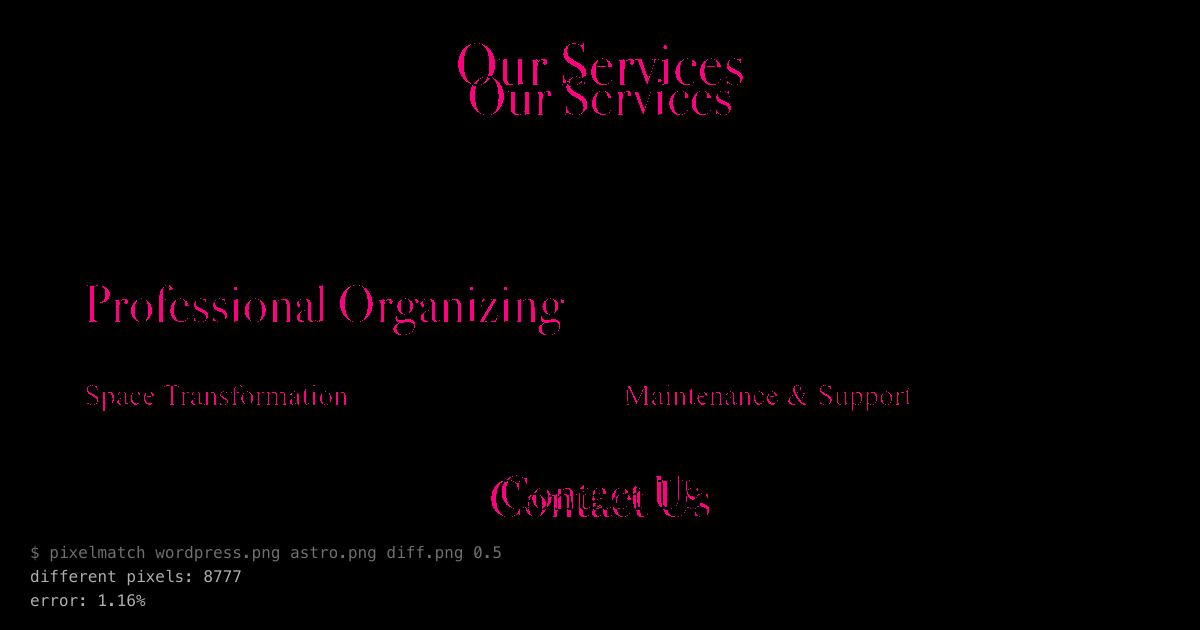
This was a task that AI would be great at, but obviously I don’t want to review every single page on the website to ensure it’s been exactly duplicated. What I used instead was the Playwright diff tool — which measures the difference between two screenshots. I had AI point this tool at both websites and then had the LLM self-correct until the difference between the two sites was within an acceptable margin. Since this was a static site I then had confidence, even without viewing the fully migrated website, that it was correctly migrated. This migration was a form of copying where functionality was all that mattered.
Pixelmatch output from the migration — pink is where the site still disagreed with the original
There’s a caveat here — just because the functionality was correct for my website does not mean the code is good. We could have just generated a mountain of slop. The reason why this doesn’t matter for my specific case is that since it’s a static site there isn’t a lot of hidden complexity that can bite me. Having unmaintainable code is also a problem, but that’s now the AI’s problem, not necessarily mine in this case. When the verification is durable and generation is cheap, the code becomes cattle and not pets.
Duplication at scale
JustHTML by Emil Stenström is another vibe-engineered example where using a test suite from an existing HTML parser became the verification jig. Actually generating the code was much less important than verifying it on the test suite. It’s worth reading the full scope of his verification jig —
He hooked in the 9,200 test html5lib-tests conformance suite almost from the start. There’s no better way to construct a new HTML5 parser than using the test suite that the browsers themselves use.
He picked the core API design himself—a TagHandler base class with handle_start() etc. methods—and told the model to implement that.
He added a comparative benchmark to track performance compared to existing libraries like html5lib, then experimented with a Rust optimization based on those initial numbers.
He threw the original code away and started from scratch as a rough port of Servo’s excellent html5ever Rust library.
He built a custom profiler and new benchmark and let Gemini 3 Pro loose on it, finally achieving micro-optimizations to beat the existing Pure Python libraries.
He used coverage to identify and remove unnecessary code.
He had his agent build a custom fuzzer to generate vast numbers of invalid HTML documents and harden the parser against them.
Jarred Sumner recently migrated Bun from Zig to Rust using a fleet of LLM agents. Rust was simply a better fit at the scale Bun operates at — to prevent memory bugs. There was no way for him to eyeball a million lines of Rust, so he vibe-engineered the migration instead.
The key was that the verification tool, i.e. the test suite, already existed. Bun’s million-plus tests allowed the Rust port to be faithful without behavioral changes. One wrinkle occurred during the migration: Claude at one point started erasing functions that were causing errors and giving long explanatory comments — which is exactly the issue I pointed to earlier that we’re all familiar with. Sumner’s workaround was to have the reviewer models catch when an edit contained a long comment and simply reject that change.
Duplication as a service
Duplication is useful — having AI offer Copying As A Service can be handy. The team at StrongDM built something called Digital Twin Universe. They decided to build replicas of Slack, Jira, Okta and various other applications their software integrates with. The replicas could then be used to test their integrations without needing to worry about rate limits or API costs.
They built these replicas by using public API documentation and SDKs. Their Digital Twin Universe needed to integrate completely with those specifications and through that the StrongDM team could verify for correctness without needing to trawl through the codebase.
Duplication as benchmark
John Regehr evaluated the Claude C compiler by using fuzzers (Csmith and YARPGen) — which revealed 34 bugs. He then pointed Codex at the compiler and had it self-repair against the fuzzing feedback, eliminating every bug the fuzzers could find — though, as Regehr is careful to note, that’s not the same as correctness.
Regehr makes the point that since there was no verification step for optimization, CCC had optimizations that were elaborate, yet didn’t meaningfully improve its output. If an axis isn’t measured, the LLM will not work to improve it.
He gives the example of how adding executable oracles (Regehr’s term) for the various axes on which software can be evaluated will allow for the AI to optimize those specific features — see his description below on generating dataflow transfer functions.
Recently I asked Codex to start writing transfer functions. By itself, it’s not bad at this, but not great. However, given access to our command-line tools for evaluating the precision and verifying the soundness of a transfer function, Codex produced results that are better than anything I’ve seen either in a real compiler like LLVM, or in our own randomized synthesis results. The remaining degree of freedom that I left Codex—code size—allowed it to write pretty large transfer functions that explore some pretty deep case splits on the input structure, but capping the size of generated code is the easiest thing.
So are we cooked? Are our jobs disappearing? No — at least not yet. ProgramBench is an eval that hands the LLM a compiled application and asks for a duplicate. The AI gets the compiled binary and its docs but can’t decompile it, look up the source, or go online — so it can never close the loop against the hidden test suite. Results have been poor — across 200 tasks from tiny CLI tools to FFmpeg and SQLite, no model solves a single one outright — even the best (Claude Opus 4.7) passes 95%+ of tests on only 3%.
Conclusion
The shape of AI-generated code no longer matters as much as the verification around it. The rest of the AI code can be a black box and we can ignore what’s in it — depending on what you’re building.
Bun’s port ended up having 19 bugs, the result of semantic differences between Zig and Rust. My static site can tolerate slop code since all that matters is the screenshot diff. Airbus, however, which is appropriately risk averse — formally verifies some of their software to ensure that it’s correct. Use LLMs at your own risk!
A good feedback loop to validate AI output is an underrated alternative to having a human review every line. The work doesn’t disappear, however — engineering moves up a level into designing what the feedback loop should be.
Vibe-engineering is only “engineering” if the AI’s verification lives outside it and leaves no opportunity to cheat. Otherwise it’s just vibecoding at scale, which is to say automated hoping.
When I first began learning about the Roman Empire in middle school, I was most interested in what everyone else seems to be interested in — the time of Caesar and Augustus. Recently, however, I’ve become far more interested in the decline & fall of the Roman Empire. You always hear the date 476 as the definitive end. As far as dates go, 476 is as good a date as any to mark the end of the official Roman Empire, but it always struck me as a bit weird. After that date, could it be said that Rome no longer existed? When I investigated what Rome was like after 476, it seemed oddly continuous. The fundamental institutions mostly existed, and life went on as usual. Nobody at the time figured that was the end.
My favorite figure in the post-Roman period is Theoderic — ruling 493 to 526, twenty years after the “fall” of Rome. He took over the structure of the Roman Empire and ruled it as a functionally emperor-like figure. He was a Goth and an Arian Christian, or in other words, a barbarian and a heretic. He spent his youth as a hostage in Constantinople, which enabled him to understand the Roman system from the inside.
The fall of 476 was notable primarily for symbolic reasons. A general named Odoacer deposed the last western Roman emperor and shipped off the imperial regalia to Constantinople — ending the chain of emperors. He controlled Italy not as emperor, but as king — albeit keeping the Roman civil service intact. Theoderic was sent by the Eastern Roman Emperor in order to depose Odoacer, which he did first with an army, then with his own hands, at a banquet.
When he took over the machinery of the Western Roman Empire, he was able to preserve it for 33 years, longer than the previous nine western emperors combined. Things that people associate with the Roman Empire continued on under his care. Roads were repaired, trade continued, things generally ran well. This isn’t to say that everything was wonderful, but it didn’t seem clear at the time that Rome was in terminal decline and would never again rise to where it used to be.
At a real level, the Roman governmental system remained. Theoderic was not an emperor per se, but he did hold official titles which were associated with the Roman Empire. He technically was titled as magister militum and patricius — the legal fiction legitimizing his rule as custodian of the Western Roman Empire. There’s a lot of symbolic continuity through those terms! The Consuls continued to be appointed — Theoderic chose the western consul and Constantinople confirmed his choices. In 519, Theoderic’s son in law Eutharic actually held the consulship together with emperor Justin. Theoderic’s imperial communications were written by Roman scribes and writers who continued writing in the Roman imperial style (chancery style), which was at that point extremely intricate and could only be interpreted by well educated Romans. Even the communications with his bureaucracy and other government officials utilized Roman means and methods. The Senate continued to meet under Theoderic’s rule — the continuity of local power was maintained.During Theoderic’s visit to Rome in 500, he addressed the Senate, organized one of the last games ever in Rome, and likely created the gold medallion of himself to commemorate the occasion.
Portrait in imperial costume, but the text shows Rex, not Augustus, and he has a Gothic mustache. Note that regular coinage still bore the face of the Eastern Roman Emperor
After the Goths invaded Italy and defeated Odoacer, there was no competing military force — the Roman army was long gone and Odoacer’s army was destroyed. It was straightforward to swap the command top-down for a different military while keeping the civilian Roman infrastructure in place. This was enabled by a reform Diocletian began and Constantine completed: the separation of civilian and military command. The new magister peditum and magister equitum (later combined into the title of magister militum) sat on an entirely different career track from the provincial governors. The purpose behind this was to reduce the number of military coup attempts — governors with legions kept attempting to usurp the emperors. This parallel authority structure, which existed at the time of Theoderic’s takeover, meant that civilian governance could continue on as it previously had existed while the Gothic army could hot swap into the place where the Roman imperial army used to be. The exact reform that was intended to prevent internal strife enabled the easy docking of a foreign army onto the Roman state. This was a real discontinuity, but it didn’t disrupt the rest of government or regular life.
After Theoderic and his Goths invaded Italy, he needed to reward his Gothic army. He decided that the best path was to grant them land. Land, in this case, really means land rent, aristocrat style. Tenant farmers work for you while you collect rent and relax on your estate. This was accomplished in an extremely Roman way — the land redistribution was run by a Roman, Liberius, operating through the Roman bureaucracy. Liberius was given the office of praetorian prefect and he was represented locally by officials of the prefecture called delegatores. Once the Gothic recipients got their land, they also received certificates (pittacia) detailing their title of ownership. The Roman bureaucracy was present, useful, and was still able to serve Theoderic’s purposes. There is an interesting argument about whether the redistribution was monetary or whether it involved land actually changing hands. Walter Goffart, in an influential 1980 book, makes the argument that the land redistribution left so few detailed records that it implied the land was not actually redistributed, but instead only the money from the land was redistributed in the form of payment. Many historians think that real land did change hands, but I think the important point is that land redistribution was such a routine operation for the Roman bureaucracy that this generated no particularly noteworthy amount of paperwork. This was simply considered a matter of course.
In 523, Constantinople began persecuting Arians. Theoderic, king of a Catholic Italy, became suspicious of the Roman elite. His attempts at finding treason included putting Boethius on trial — who wrote the Consolation of Philosophy while awaiting execution. The first cracks in the West’s stability came from the East.
Within a decade after Theoderic’s demise, the Ostrogothic state had irreversibly begun disintegrating, and the Italian peninsula became a violent place. Succession to the throne led to infighting among the Goths, then Emperor Justinian began a reconquest of Italy. Akin more to cannibalism than conquest — the Eastern Roman Empire and not barbarians at the gates caused the collapse of Roman society. To give an idea of how bad it got, Venice was settled in the decades of chaos after Theoderic’s rule because Italy had become so dangerous that it was preferable to live on the water.
Rome was still around for a while after 476. The people were still around — the real disorder didn’t start until 50 years or so after the official fall. Political change doesn’t necessarily destroy culture in the same way that physical destruction can. The archaeological record after the official fall faced a steep decline, but it was continuous. The lights of Italy dimmed slowly into a long dusk.
So you have a plot of land in New York. You want to put an apartment building on it. What does it look like to actually accomplish this?
A pretty usual New York City plot of land that you would put an apartment building on is 25 feet by 100 feet. This is pretty common in brownstone Brooklyn and parts of Manhattan. Let’s say this is what you inherited and you own it free and clear.
Considering we’re in a housing emergency, I’d say that it’s essential that such a standard piece of land be easily turned into new housing. In an ideal world, it’d be easy to construct some new apartment units for people to live in.
Unfortunately, due to the weight of regulations, which individually can be defensible or even crucial, this apartment building that you’d like to construct won’t pencil out.
Let’s walk through why it matters. It’s worth saying — high housing prices are the result of supply and demand. New York has had a rental vacancy rate below 5% — the legal definition of a housing emergency — for decades. As of 2023 it was 1.4%, the lowest since 1968. If there is a profit to be made, people will seek profit. A lot of housing comes from people who seek a profit — they’d love to build housing if possible!
Here’s the number we’re going to track: $4,000/month. That’s a good assumption on what the market will pay for a new one-bedroom. It’s the rent you can realistically collect from each unit once the building is standing. We’re going to watch this $4,000 get eaten by regulations, line by line and — spoiler alert — you’ll not only not make money, but you’ll be losing $3600 a month. It’s no wonder that more housing isn’t being built here.
Design
Let’s say that your place is in Manhattan, in the East Village. This means that one of the zones that’s prevalent there is R7A. Let’s say that your plot falls under that zone. In case you’re curious, you can see what zones exist in New York City at this link. Zoning regulations explain what the city allows you to build on that plot of land.
Since you’re in an R7A zoning district—a medium-density residential zone that actually allows apartment buildings as-of-right, this means you don’t need to beg the city for permission. Much of New York doesn’t allow this. Vast swaths of the city are zoned exclusively for single-family homes, untouchable without a years-long rezoning process you have no intention of starting. This is a generous assumption — in many cases you need to do the rezoning.
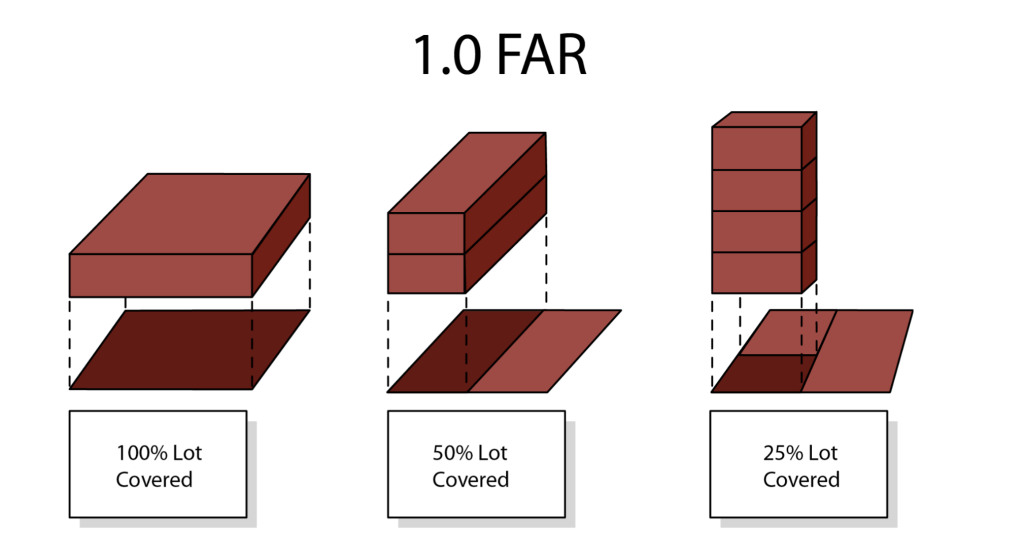
Based on the zone, you’re not allowed to build as many units as you’d like. You’re limited by a concept called FAR, which stands for floor area ratio — fundamentally it’s a regulation on the level of density a lot can have. For R7A, the FAR is 4.0 — this means that since you have 2,500 square feet of land you will be able to build 10,000 square feet total for the units of the building.
FAR isn’t actually the binding constraint here — the total volume restriction is. Raising FAR wouldn’t help much. Height limits and yard requirements would cap you at roughly the same density. The deeper problem is spreading fixed costs (architect, engineers, elevator) across a handful of units. This makes building a smaller apartment unlikely.
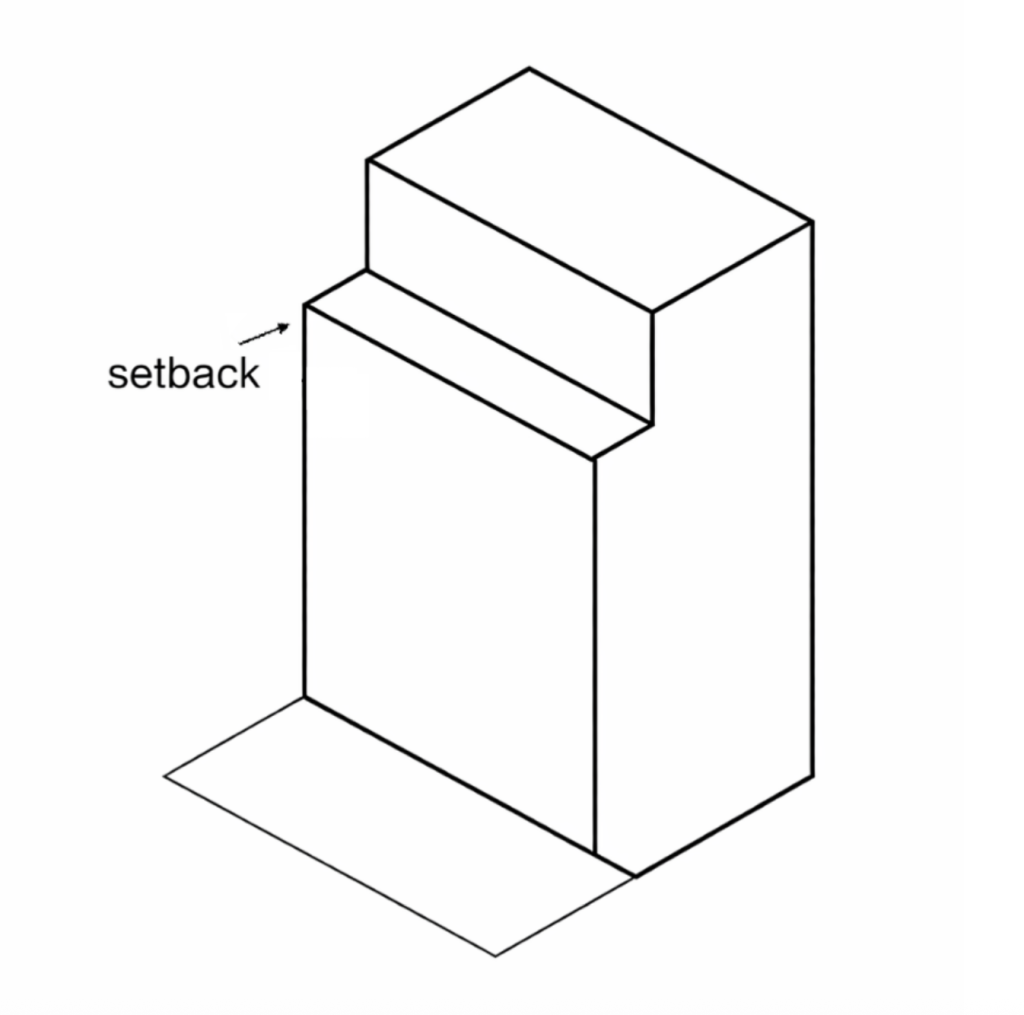
The shape of your building is also determined by the zoning regulations. You’ll need to have your wall up against the street for at least 40 to 65 feet (depending), and then you’ll be required to set your wall back at least 10 to 15 feet (also depending). This means that you can’t decide the shape of your own building — the aesthetics are set by regulation.
You’ll need a rear yard. Yes, I agree it’s wonderful for residents, but as Jerry Reed said, “I was gonna do what’s right, give ‘er her fair share but, boys, I didn’t know her share was gonna be that much”. Unfortunately, you’re required to give a 30 foot yard at minimum, which leaves you with 70 feet of buildable depth.
You are also required to only cover 65% of the lot, so despite the required rear yard, you’ll still need to cut down the lot coverage a touch more, so you’re at the required coverage percentage. Fortunately, you get to choose where to cut down the floor area!
Your 2,500 sq ft lot gives you 10,000 sq ft at FAR 4.0. But the 65% lot coverage cap limits your footprint to 1,625 sq ft — which on a 25-foot-wide lot means a building 65 feet deep, comfortably inside the 30-foot rear yard. Following the setback rules you get 9,375 sq ft, six stories, six units.
This means the building will be rather small — which means it’s unrealistic for New York. Fixed costs, like dealing with permits, or an elevator, mean that you can’t recoup investment at that size. The building would need to be much bigger to get built.
Six units at $4,000 each. That’s $24,000/month in gross rent against whatever it costs to get this thing built and operated. So far, the design phase has cost us nothing — we still have $4,000/unit/month to work with. Now we start spending it.
Construction
Great! You’ve got a 6 unit building in the works, so you decide to hire an architect. They inform you that since you have more than two units, you’re classified as R-2 occupancy. This triggers a cascade of requirements.
Fire-resistance-rated partitions between every unit (1 hour of fire resistance). Fire-rated corridor walls (1 hour). Fire-rated stairwell enclosures (2 hours, because you’re residential). Automatic sprinkler systems throughout, following NFPA 13 standards with New York City modifications. Fire alarm systems that require FDNY approval before installation. This all seems pretty reasonable to you. After all, fires in apartment buildings are pretty dangerous.
The sprinklers alone will cost $3–5 per square foot, assuming a NYC premium. For your roughly 9,000 square feet of actual building, that’s $27,000–$45,000 just to not burn down.
You would have been exempt from adding an elevator if you squeezed into 4 floors, but since you’re at 6 you’ll need one. That’s another $200,000 and a pile of additional code requirements.
Then there’s accessibility. Under the NYC building code, every unit with elevator access must meet “Type B+NYC” standards — which exceed federal requirements. Accessible routes through units, accessible doorways, switches within reach ranges, reinforced bathroom walls for grab bars, accessible kitchen and bathroom configurations. This is why if you live in a new construction building, your bathroom is gigantic — it’s to accommodate wheelchairs.
Oh, and as of January 2024, Local Law 154 bans natural gas in new buildings under seven stories. You’re going all-electric: heat pumps, induction cooktops, electric water heating. Your contractor hasn’t installed an all-electric building before and therefore quotes you a premium for the learning curve.
You can’t actually decide what the exterior of your building will look like — the facade you’ll choose has to pass NFPA 285 fire regulations. The energy code requirements push you towards continuous exterior foam insulation, which rules out traditional masonry and forces thin panels. This limits what you’ll be able to pick and makes it more expensive.
NYC also has specific concrete requirements that exceed national standards. Your concrete supplier will need to provide you with a NYC specific mix. You’ll need inspections for each concrete pour from a special inspection agency which files reports with the DOB.
Hard construction lands at roughly $400/sq ft — the NYC premium. For 9,375 sq ft, that’s $3,750,000. Spread across 6 units and financed over 30 years at 7%, you need $4,160/unit/month just to service the construction debt.
About two-thirds of that $4,160 is what a merely-expensive American market would cost. The other third is the NYC code stack: the sprinklers, the elevator you needed because you have six floors, the all-electric premium, the metal conduit, the NYC concrete mix, the NFPA 285 facade, the accessible bathrooms.
Running tally:
$4,000 starting rent
−$2,775 base construction mortgage → $1,225 left
−$1,385 NYC code premiums → −$160 left
Permitting
You’ve got a plan, and your head has stopped spinning. You’ve been paying interest on your loan this entire time, by the way. Glad you’ve rested up though, because now it’s time to deal with permitting.
Your architect submits an application to the Department of Buildings. This triggers requirements for a dozen associated filings: foundation permits, plumbing permits, electrical permits, elevator permits, fire suppression permits, boiler permits. A licensed architect must seal the architectural drawings. Professional engineers must seal the structural, mechanical, electrical, plumbing, and foundation designs. You are now paying five different licensed professionals to stamp things.
Initial plan review takes six weeks. You get back a list of objections: incomplete documentation, inconsistencies between the plans and application data, missing energy code analysis. Your architect fixes them and resubmits.
Four weeks later, another round of objections.
Your architect suggests professional self-certification — licensed architects can certify that plans comply with all laws, skipping DOB review entirely. Approval happens instantly when you submit. But 20% of self-certified applications get randomly audited, potentially requiring construction modifications after you’ve already built. You decide the audit risk isn’t worth it and stick with the regular review process.
Third round of objections. Your architect fixes them. Six more weeks.
Finally, approval.
Soft costs for a project like this run ~22% ofhard costs — about $825,000 for your five engineers, expediter, attorney, surveyor, insurance, DOB filing fees, and environmental reports. Plus carrying costs during construction: an 18-month build at 8% on the loan — let’s say it’ll be $300,000. Plus a 10% contingency on hard costs: $375,000.
−$350 carrying costs (interest on the loan during construction) → −$1,410
−$400 contingency → −$1,810
Environmental Review
It’s very lucky that you’re building as-of-right. If you needed any approval from the city — a variance, a rezoning, city funding — you’d trigger environmental review, a process that studies nineteen areas of potential impact including whether your building would cast a shadow on a park. The CEQR Technical Manual specifies that your building’s longest possible shadow is 4.3 times its height, calculated on the winter solstice. If that shadow so much as touches a playground, you need to commission a shadow study across four representative days of the year. The full process can take years and cost six figures.
Property taxes
You knew property taxes would be significant. You didn’t know they’d be this significant.
New York City’s property tax system charges apartment buildings at an effective rate roughly five times higher than single-family homes. New construction doesn’t qualify for the assessment caps that protect older small rentals, so DOF values your building by its rent roll and taxes it at the full Class 2 rate — roughly 6% of the building’s value every year. Let’s say your building will owe somewhere around $130,000 a year, or $1,800 per unit per month, just in taxes, before mortgage, maintenance, insurance, or a single dollar of income. I talked to Michael Johnson from NYAA who says my number is actually on the low end — see this comparable building here.
To recap – the median rent in Manhattan is $4,695/month. With $1,800 (or more!) gone every month for property taxes, this building could never be affordable for renters — and it’ll never even get built.
You could have avoided this by using the 485-x tax exemption (the successor to the old 421-a program). In exchange for including some affordable units, you get a property tax abatement. In certain Mandatory Inclusionary Housing zones, you don’t even have the choice—affordable units are required by law.
So technically, you could avoid the property tax! You can sign up for 485-x! Unfortunately, it doesn’t really work. The requirements of following 485-x are byzantine and would require a whole other article. In short — taking the property tax abatement would destroy your project with a dizzying array of yet more stringent requirements.
You’re as-of-right, which means that your apartment plan is pre-approved, so you skip environmental review. But the 485-x tax abatement you missed out on? That requires a discretionary approval. So if you had tried to get the tax break that makes your building financially viable, you could have triggered the environmental review that makes it financially impossible. That’s just one example of the tangle of regulations that 485-x brings with it.
Soft costs (five sealed engineers, attorney, expediter, DOB filings)
−$900
Carrying costs (interest while you wait for stamps)
−$350
Contingency
−$400
Property taxes
−$1,800
Net
−$3,610
To break even you’d need to charge roughly $7,610/month per unit and we haven’t even looked at operating costs or the cost of the land. The market will pay you $4,000. The building never gets built.
Conclusion
This level of regulation is unusual, both compared to other cities in the US, and also worldwide. NYC is the most expensive construction market on Earth. No single regulation here is indefensible. The problem is that together they make the math impossible.
What makes NYC housing work despite all of this? Mostly, it doesn’t. NYC permitted just 15,600 units in 2024. The buildings that do get built are large, luxury, publicly subsidized, or some combination of all three. The modest six-unit apartment building is extinct.
What makes different cities different? Why is it that your daily life takes a different structure when you’re in a new spot? The small things about the built environment make a massive difference in the texture of your daily activities. We’re talking about things like where you get coffee, where you get groceries, how you do those things.
Land use regulations & zoning are one of the biggest ways cities shape themselves. The pitch is reasonable — people probably shouldn’t live next to factories, so let’s have rules about what gets built where. Think of it like an HOA for your entire city — collective decisions about what should and shouldn’t be allowed, in the name of common benefit. Like an HOA, it goes wrong sometimes.
The big stuff — I think everyone understands. Everyone gets that LA has better weather so you’ll likely spend more time outdoors than in NYC. The smaller stuff, I think, people underestimate. If your neighborhood doesn’t have a small coffee shop nearby, you won’t buy coffee that often. I understand, of course, that you in particular may continue to go out of your way for coffee, but in aggregate, this will be a much less coffee drinking area.
I’m talking about the texture of your life — whether you enjoy going to your grocery store, whether there’s anywhere for you to sit outside your home, or what you decide to do on an afternoon when the weather’s nice and you’re done with work. The rhythm of a neighborhood is the result of what’s within reach. People take the path of least resistance — you do what’s easy, you skip what’s hard, and over time that becomes your life.
This isn’t just how the world naturally works — these are deliberate political decisions being made on your behalf, often without your input. The political choices made surrounding how land is used affect your life and they affect it in ways that you may not realize. Small choices and regulations in terms of how land is used affect the texture of your life.
Consider how your day is shaped by your environment. It’s all fundamentally malleable! People made this and people can unmake it. Everything in your environment that was built needed to be decided on.
Let me give a few examples:
Work
Downtown San Francisco is primarily offices, and most people live in the surrounding areas. People primarily live around downtown, they’ll commute downtown to work at their office, and then they’ll commute back home. This means that the entire transit system is set up for this as well. If you’re looking to commute into and out of downtown San Francisco, it’s very easy. If you’re trying to get from one part of the city to the other, it’s not really designed for that. I spent 3 months in San Francisco, and you can feel it when you try to commute from one part to the other — it feels more complicated than it needs to be.
Why is the downtown commercial area so filled with tall office buildings and the rest of San Francisco so short? Is it because of seismic activity? Unfortunately, this isn’t the case — the spot where all of the tall skyscrapers are is actually the least seismically safe part of San Francisco. Downtown is all infilled soil rather than rock. In fact, one of the office buildings actually has a large amount of tilt because it’s built on unstable soil. Unfortunately, the tallest buildings in SF are the most unstable because of zoning.
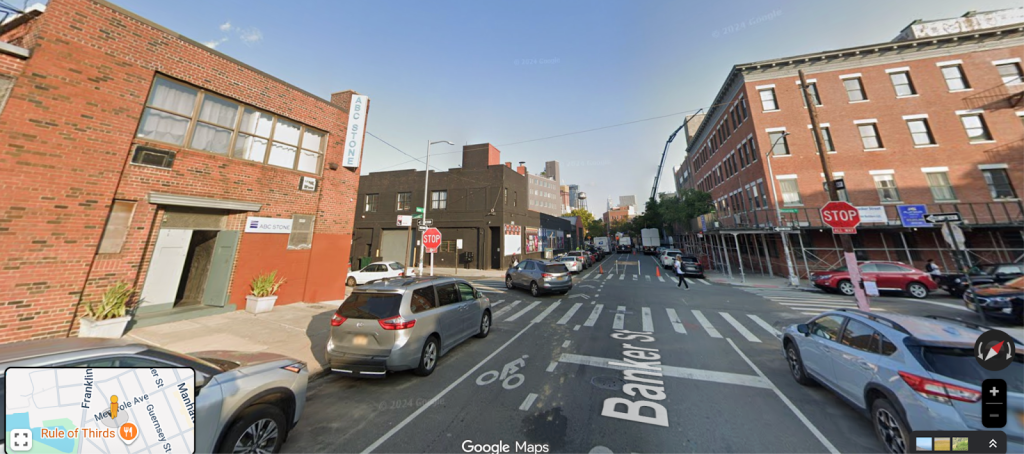
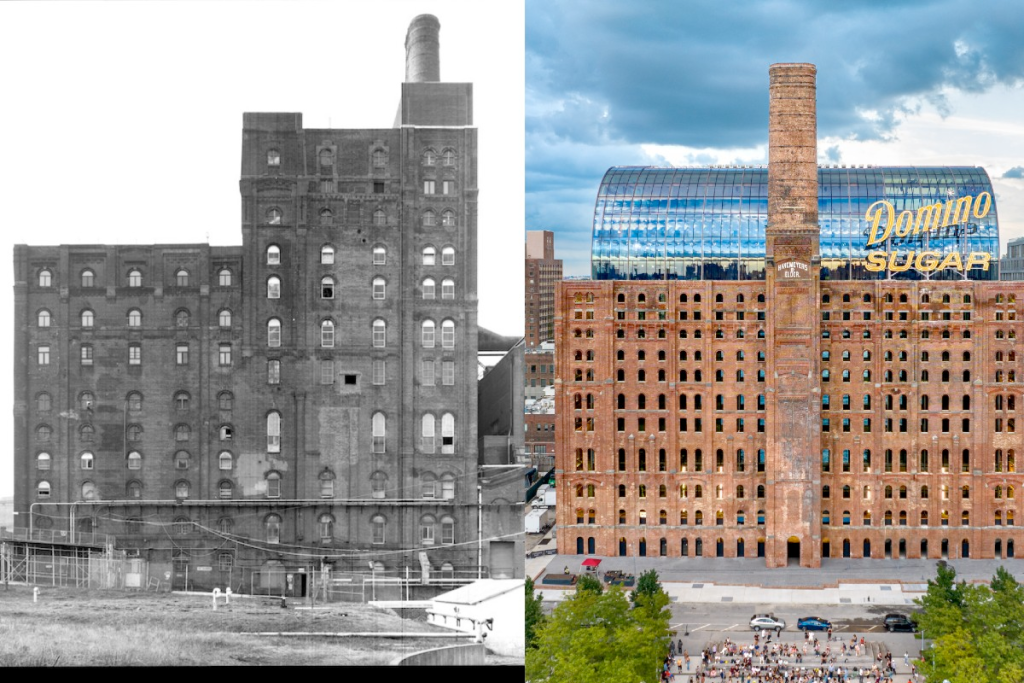
While San Francisco keeps work and home firmly separated, other cities show what happens when you blend them together. Williamsburg in New York is a great example of mixing work with homes. I lived in Williamsburg for over a decade, and it’s this interesting mix of post-industrial warehouses and factories turned into housing and stores. Williamsburg used to be a big industrial area and then it was rezoned in 2005 to allow for housing development. There’s also actually quite a big remnant of industry that still functions and parts of the area are still zoned industrial. There are warehouses full of marble tabletops right next to where people are living. It gives it that sort of “real” vibe. The industrial & residential mixes in a way that contributes to it being the hottest part of New York right now.
For example, there is a marble tabletop factory on the left (ABC Stone), apartment buildings right across the street.
Domino Sugar Refinery (Williamsburg, NY)
Family
Daycare in the US is wildly unavailable. There are a lot of reasons for this, but one that might surprise you is zoning — daycares are often zoned like they’re commercial enterprises, when in reality they’re more of a community need. I don’t have kids, but from what I’ve read — it’s difficult to have enough daycares to where the prices are reasonable. In Nashville, for example, daycares are required to be dispersed at least 1,000 feet apart and they aren’t allowed by default so each daycare needs to be individually approved. I looked up how hard it is to open a daycare in NYC — even once you find a space, you need a Certificate of Occupancy that specifically permits community facility use. On top of that, you need approvals from multiple agencies — the state Office of Children and Family Services, the city Department of Health, the Fire Department, and the Department of Buildings. This stalls the whole process for months before a single kid walks through the door. This raises the cost of opening a daycare — which means there are fewer around.
Car-dependent suburbia requires that the elderly continue driving well into their old age after it stops being safe. There’s fundamentally no way for them to get around without a car in these kinds of places. Taking away their driver’s license would be tantamount to putting them under house arrest — so the road system ends up creating broader problems around public safety, independence, and isolation that go well beyond just driving. Life and safety is shaped by the regulations — if they could walk around it would be more politically palatable to ensure driver competency. It would be easier to make the road safer for everyone. It’s a good example of how zoning ends up intertwined with issues that seem very far removed from local ordinance.
Cross the street grandma!
Home
In many parts of the United States if you have a property with a home on it, it is not permitted to put another small home on it or to build a duplex. If, for example, you have aging parents and you want them next to you, you aren’t able to build an ADU (a small second home on the lot) simply because it’s forbidden by the zoning regulations. Similarly, if you want to build a duplex to rent out the second unit, you aren’t able to do that, even if you want to rent it to a friend. Fortunately, many municipalities have decided to change the regulations around this. For example, Los Angeles recently made a big change where they started allowing ADUs.
Example of an ADU
If you wanted to run a small business out of your home — in most parts of the US, that’s illegal. Sometimes it’s legal to run the business, but it’s illegal for customers to visit you at that business. This prevents a lot of the wonderful tiny businesses that exist, for example, in Japan where people have a cafe that they run out of the first floor of their home. You don’t allow entrepreneurship, where somebody can for a summer try out running a cookie shop out of their home and then they can graduate to something bigger. The barrier to entry is much higher when you need to rent a space just to start a tiny business — think of how many cookie shops we’ve missed out on!
I picked these examples because they’re the simplest things — so basic that you’d have to actively try not to notice how they differ from place to place!
It isn’t just zoning of course, it’s a combination of culture, laws resulting from culture, finance, local input. The way an area looks is the product of zoning, building codes, fire codes, parking minimums, taxes, insurance, lending preferences, developer economics, community input, and culture. No single rule produces the outcome — but I want to point to zoning as an indicator. Zoning is the one set of rules that most directly encodes what’s allowed to exist near you — it’s something like a codified set of cultural expectations on what a space is meant to look like.
Strangely, all of this has made me more optimistic. Being precise about what you dislike is useful — it turns frustration into something you can work with. I want to know the exact rule that says I can’t run a cafe out of my living room! Once you can point directly at the problem, you can work to change it.
If you’re looking through a security camera at me during a regular workday, there’s not really that much happening. I think that internet use is a natural reaction to living a life which is pretty much the same every single day.
I was very lucky to be unemployed with my wife for three weeks between jobs. Our unemployment breaks came about from job offers at companies that graciously allowed us later start dates. I think it’s important to note that it’s a different flavor of unemployment when you know when your next job is starting, than when you’re unemployed indefinitely. It means you can be a bit more profligate with your money since you know that the next paycheck will come in soon. Also, I think that there’s a psychological aspect — you don’t feel the unemployment depression.
During my years of employment, I had accumulated a lot of fun things to do in New York that I’d never had time or energy to do. I did complete a few items off the list, but you just can’t get through that many when you’re working — there’s simply not enough energy or time. When employed, the weekends are a time of recovery, so you can go back to work the rest of the week. The time technically exists, but using it for fun means sacrificing maintenance elsewhere and your life falls apart a bit.
I also wanted to try a screen-free period. My plan was to have my wife take over my phone and computer, and I would get to pretend that technology doesn’t exist.
Overall, my three weeks of screen-free time were extremely pleasant. I only had some sort of minor withdrawal symptoms for the first six hours — I had this phantom phone feeling where I kept wanting to check my phone and then seeing that it was no longer in my pocket.
Of course, this plan was inconvenient. I began by having my wife check & respond to all my messages for me, which turned out to be very onerous. I had to adjust to modern realities by batching all the messages and responses into like a 20-minute session at the end of the day. I’d still, however, characterize my time as still substantively screen-free. I was pretty good about keeping myself on task during the message answering sessions.
I purchased myself a dumb phone for the screen free period, but I ended up needing to carry the smartphone around regardless. If, for example, I was meeting up with someone, it was difficult to tell people what my new number was and explain the whole situation about being screen-free. It was simpler to just carry the smartphone and turn it on only when I was actually at the meeting spot.
I wish I could say that I gained some superpowers, but overall, I just felt like I had more time & energy. My days didn’t slip by like they used to. I didn’t get sucked into screen time. I got a hell of a lot more reading done. I was reading just about one book every three days — the reading replaced my screen time.
It also became clear to me — with no small amount of surprise — how many hours I spend googling random things out of curiosity. So, I started writing down my questions and then batching them for the end of my screen-free time. I think that helped me stay more connected to the real world rather than getting sucked into Wikipedia rabbit holes. The optimal amount of rabbit-holing is definitely non zero, but I think I was on the far side of the healthy amount.
I’d like to shift my life away from excessive Internet consumption. Being away from screens was lovely. The downside is that I would miss out on lovely blogs like Patio11’s Bits About Money and Works in Progress magazine. It’s easy enough to say that I should stop browsing the Internet outside of proven good content, but then that breaks the discovery mechanism. I’d want to do more exploit than explore, but exploring is essential. Yet, the exploration I do is mostly a waste of time — what the hell do I do?
I ended up doing a lot of things during my unemployment. I’ll include a list below.
Wild food foraging in Central Park
Hiking trail repair
Many museums
Hiking
Archery
Fishing
Horseback riding
Tour of Rockefeller Center
Pistol shooting
Beach day
Walk from the tip of Manhattan to the bottom
Sailing
Picnic in Central Park
I actually got the compliment multiple times that I was the person best at being unemployed that they had ever met.
I spent a little bit of time before my unemployment planning in detail exactly how I was going to use every single day without overplanning it. Below is an image of my plan ahead of time.
I’m not too much of a fan of overplanning. So, in addition to this, I had a very long list of potential filler activities for the empty days. Then, as we woke up, depending on our mood, we could choose what activity we wanted to do that day.
All I wanted to know was how the NYC government works and now I’m insufferable at parties.
Around 90% of people arrested in NYC are released after their arraignment. After a person is arrested, they must be brought in front of a judge to have their bail set prior to their court date. The purpose of bail is to prevent someone from escaping before they have a chance to go to trial. It’s worth remembering that, at this point, the person hasn’t been convicted of anything — they’re presumed innocent and have only been accused of a crime. Historically speaking, most bail was set using money. The judge sets a sum of money that the defendant must pay to be released prior to the court date — this is then held as a deposit, which is returned after the court case finishes. The alternative is that you are jailed, which in NYC means an average stay of 104 days before your trial begins.
New York State reformed their bail system in 2019. The main thrust of the reform was to remove cash bail. Since 2019, the legislature has walked back parts of the reform through three rounds of amendments, which allowed bail for various violent crimes, felonies committed while on probation or parole, repeat offenses involving harm to people or property. The 2023 changes removed the “least restrictive means” standard, giving judges broader discretion to ensure defendants returned to court.
The idea was that having cash bail led to bad outcomes, because if you were poor you were more likely to be disproportionately affected by cash bail. The amount of time the money would have to be surrendered was a massive barrier for poorer accused. Whereas if you were wealthy, despite the magnitude of the crime, you’d be more likely to go free and continue with your life since high bail amounts wouldn’t be a barrier to release. There were other reasons to remove cash bail — the success of a program which supervises people released by the court run by the Criminal Justice Agency, as well as the overflowing Rikers Island and the desire to shut it down.
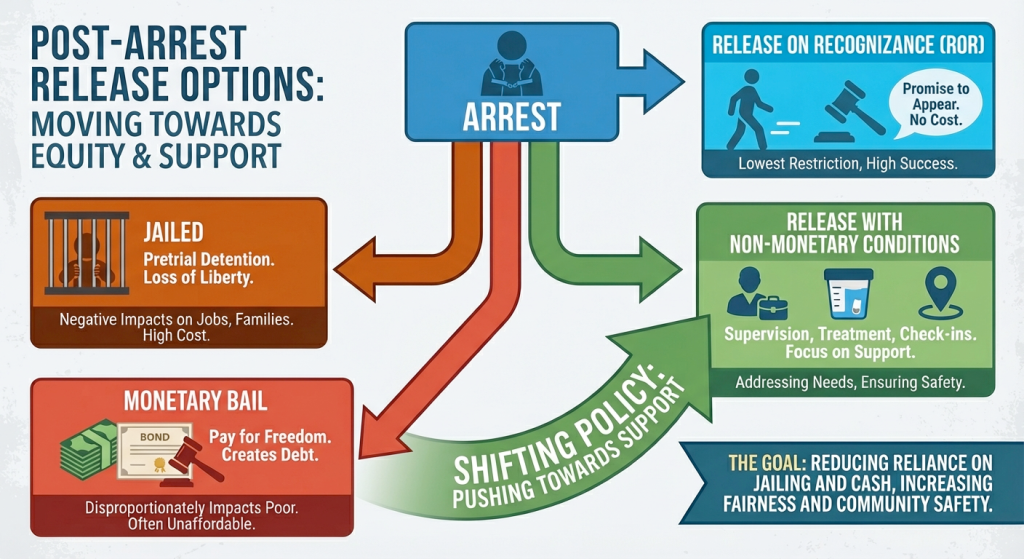
The court generally has four options when setting bail. A person can be released (ROR), released with non-monetary conditions, monetary bail, or jailed (CPL § 510.10(4)). Release with non-monetary conditions includes travel restrictions, orders of protection (restraining orders), and supervised release.
I’ve thought about this for a long time and I have some thoughts about where this works well and where it doesn’t. Also, it’s a tricky topic and it’s tough to put in nuanced terms, I’m doing my best! I’ve been to arraignments a few times now in the NY County Criminal Courthouse at 100 Centre St — they run court after 5PM there. I recommend showing up, the sessions are open to the public.
My perspective in this post is that the supervised release program is a complete win! I’m extremely glad that NYC has implemented a fairer, cheaper, more just system that’s just entirely better than what came before it. At a high level, I’m a strong supporter of the supervised release system, but also have some thoughts that I haven’t really seen before. Also, disclaimers — I’m not a lawyer and my knowledge of this extends only to NYC and not NY state.
A lot of advantages with minimal downsides
Supervised release offers many advantages over monetary bail. Most importantly, it works just as well in terms of overall outcomes — New York City’s failure-to-appear rate actually decreased from 15% in 2019 to 9% in 2021. A drop in the failure-to-appear rate is surprising, since we started releasing more people! Beyond effectiveness, supervised release reduces costs to the city (where the average cost per jailed inmate is $208,513 per year!), minimizes disruption to the accused’s life, and creates opportunities for targeted interventions through social programs that address underlying issues. The approach also improves racial equity while being more effective. This is everything I want to see — cheaper, better, more fair.
Supervised release isn’t all positive. The MDRC evaluation found that 44% of supervised release enrollees would likely have been released on their own recognizance if the program didn’t exist, suggesting it may be widening the net on who is enrolled in the program. This means that before supervised release, judges would have let certain people go free, but now are being put into supervised release. This implies that judges may end up overusing it on people who would have returned to court by themselves. The program can also burden accused individuals who struggle to meet requirements and it’s politically vulnerable to funding cuts that could reduce it to pro forma box-checking. Critics also raise concerns about increased crime from releasing individuals who would otherwise have been detained.
Overall, I’d characterize the advantages as vastly outweighing the negatives. The fundamental argument for supervised release rests on a straightforward principle: jailing someone for a less serious crime simply because they lack bail money is net negative, potentially generating more criminality in the long run than allowing them to continue with their lives under supervision — especially now that exceptions exist for no-bail policies for major crimes, ensuring those who genuinely need to be detained still can be.
Criminal Justice Agency is the non-profit that provides pretrial risk assessments, release recommendations, and runs supervised release. CJA has been fantastic! Their programs are cheaper than jail and more fair. Innocent people can continue with their life, and not enter a doom spiral. Check out this webinar about how well it works!
The idea behind the supervised release program is that many people can be trusted to return to the court day with a certain level of support. There are different tiers of supervised release, such as: a single monthly phone check-in, weekly in-person reporting, mental health treatment, or outpatient addiction treatment. The benefit of this is that by using data in a smart way, they can predict the likelihood of someone returning to court, and thus tailor the tier of supervision that person is likely to require. This works surprisingly well and has had massive effects in making New York’s judicial system much more fair and cost-effective while improving outcomes in terms of people appearing for their court dates.
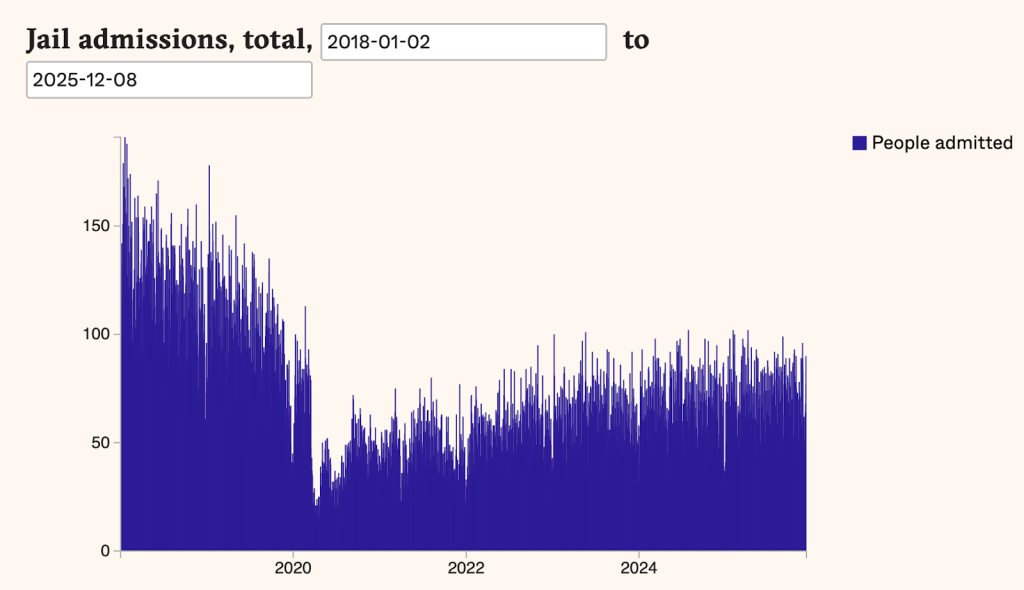
Figure from Vera Institute, showing the drop in jail admissions — cashless bail was instituted in January 2020
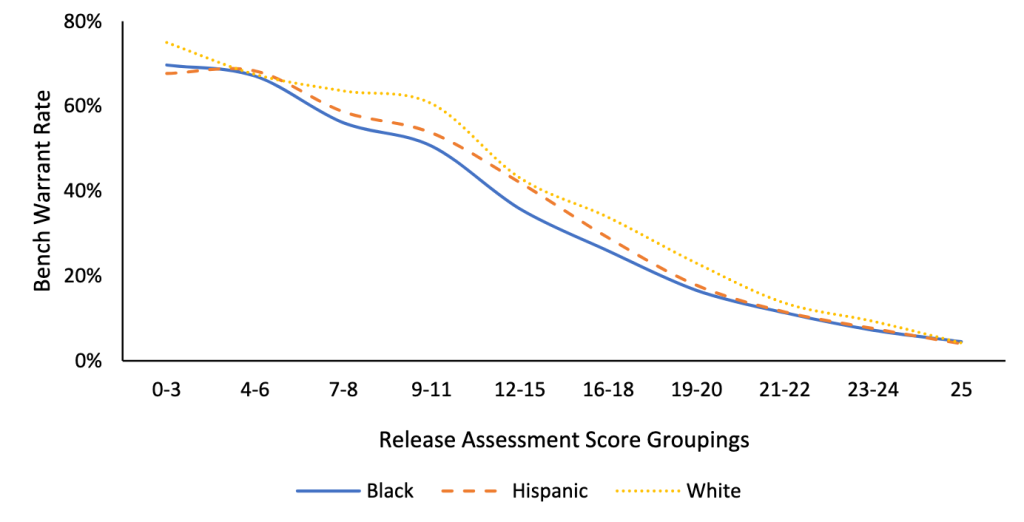
CJA also has a scoring system to determine how likely a person is to return to court — which has been developed through the data collected from running supervised release. This is something that the judges and assistant district attorneys rely on in order to determine whether a person should be released without cash bail and onto the street on supervised release. I want to reiterate that this works really, really well.
The above figure demonstrates that low (bad) release scores accurately predict failure to appear for court — across racial groups.
The CJA risk assessment considers factors like how many times the accused has failed to appear for court, recent criminal convictions, and number of pending cases. The assessment also considers community ties, measured by factors such as years spent living at the last two addresses and whether they can be reached by phone.
NYC isn’t the first jurisdiction to implement cashless bail. Washington DC implemented it in the 90’s, followed by New Mexico, Illinois, and New Jersey, among others. What NYC has done by reducing the usage of monetary bail is part of a wider trend. Internationally, monetary bail is rare — the US & the Philippines are the only countries with for-profit bail systems. Cash bail is generally rarely used.
Overall results inside the US have been good — meaning that reducing cash bail has not spiked crime. This may have been the case within New York City as well, where increasing the use of non-monetary bail may have not materially changed the amount of crime. I’m hedging since this is controversial and I found various studies showing that bail reform did or did not contribute to the post-2020 crime waves in cities. Overall consensus seems to be that bail reform had a minor effect compared to the COVID related changes and my gut agrees.
New York State after the 2019 reform had multiple changes to bail reform, in 2020, 2022, and 2023 that rolled back some of the measures to reduce the use of monetary bail. Speaking generally, the changes post-2019 re-allowed the use of monetary bail for violent crimes and felonies. These changes happened relatively quickly and prevented some of the more egregious problems that could arise during the implementation of cashless bail.
What happens when someone fails supervised release? Staff first attempt to re-engage the participant and alert the court. For persistent noncompliance like willfully failing to appear, committing a new felony, or violating a restraining order — courts can revoke release conditions and set new ones, including bail or detention, after a hearing.
But dangerous people get released too…
New York State has not enforced a standard of dangerousness on people being released on bail since 1971. The only characteristic that is taken into consideration when releasing someone on bail rather than jailing them is whether they are likely to return to court or not. This means that if a person is considered dangerous or likely to re-offend, this is explicitly not something the judge could take into account when setting bail conditions or release conditions. New York State is alone in this — every one of the other 49 states has a dangerousness standard.
This has put judges in a difficult position. Bronx Criminal Court Judge Jeffrey Zimmerman describes the current statute as “a confusing mess.” The Legislature, he argues, is trying to have it both ways, with each round of amendments since 2019 adding more dangerousness-related factors to the bail statute — prior firearm use, whether the charge causes harm, crimes committed — while still officially maintaining that bail’s only purpose is ensuring return to court. The “harm on harm” provision, which allows bail when someone commits a harm crime while released on another harm charge, sounds tough but is narrow in practice. It doesn’t apply if the first case is resolved before the second arrest, or if the charges don’t both qualify as “harm,” leaving judges unable to act on obvious patterns of escalation. Judges are required to consider factors that obviously relate to dangerousness, but are forbidden from using them for that purpose. The only way to make the statute internally consistent, Zimmerman writes, is to conclude that the Legislature is implicitly telling judges that dangerous people are less likely to return to court. Nobody actually believes that’s the real concern, but it’s the only legal fiction that makes the statute coherent.
Previously, this wasn’t a big issue primarily because of the existence of cash bail. When cash bail existed, the issue of dangerousness was obscured by the fact that many of the people that would have otherwise been released were lacking the stability or resources to afford cash bail and hence were jailed regardless. The 2019 bail reforms revealed a pre-existing issue that was being obscured by the existence of cash bail and the interaction with the population of people who commit minor crimes consistently, but nothing big enough to be jailed over.
One concrete example that I saw was one person who had been meeting court dates but was currently accused, on separate occasions, of burglary, attempted murder, possession of drugs, and possession of an unlicensed firearm. Since he had been meeting court dates, the judge was forced to release him yet again — despite the judge himself saying out loud to the courtroom that he had no doubt that the defendant would once again soon be accused of a crime. This feels bad to me — everyone knows this accused will reoffend, and yet is released regardless.
Frequently, these people do not commit crimes that are bad enough to be held before trial or are imprisoned for such long periods of time as to reduce their presence on the street. This means that frequently they are cycling in and out of the criminal justice system. You can see the effects of this on the profiles of the various subway pushers in New York City. Many of them have dozens of priors and a history of assaults that have simply escalated to the point where they have pushed someone onto the subway tracks. 70% of subway violent offenders had a prior arrest for violent crime during the prior six years. Despite them likely having open court cases, they’ve been released to the supervised release program.
With all of this said, supervised release is a contentious topic — there are calls to return to monetary bail for the sake of looking tough on crime. Overall, I think cashless bail is promising and the best route to protecting it and improving it is to gather more data.
The data we’d need to settle this question doesn’t really exist — at least not publicly. The main source we have on this is from the NYPD — which regardless of veracity should be confirmed due to potential for conflict of interest. CJA already collects data on reoffenses, it’d be wonderful if this would be made public to better understand the nature of the issue. A bill in the State Senate recently failed to make it out of committee — one potential reason is that statewide data collection on this scale may be simply unavailable. CJA is in the unique position of having comprehensive data collection in NYC. It’s a very long road to getting this changed. My hope is that this blog post can inspire you to take a more active stance in supporting it in informal conversations.
A year ago I decided to help build a service business for my mom because I wanted to learn about marketing and business. One of the largest blindspots engineers have is around sales and marketing. I was determined to not fall into this trap, but marketing seemed like a skill I couldn’t just learn by reading — a form of tacit knowledge. I needed some kind of sandbox to test out the marketing skills I was learning about and my mom had been bothering me to help her set up an organizing business for at least a few years now. I had previously set up an MVP website and a profile on Thumbtack (similar to Angie’s List), which provided her with a bit of side income. We decided to give it a real shot!
These are the lessons I’ve learned from working on this business. There have been a lot of reality checks — where my assumptions on how the world works have been rudely disproven.
How People Buy Things
Prior to beginning this business I hadn’t actually understood how to make money. I had begun a couple of side hustles but I always felt I was missing a key element. I was, and it’s called marketing. I know it’s difficult to believe but I just assumed the following steps
I put a product into the world
???
customers would find it and purchase it from me.
I didn’t realize that it required conscious, applied effort to get people to buy your service.
Getting people to buy things is generally a solved science. I kept thinking “no it can’t be that simple, we’re a special snowflake business”. Every single time the blindingly obvious thing that everyone was telling me to do turned out to be the correct move. I refused to believe that jamming a huge call to action button on a webpage would change conversions, I thought discerning clients wouldn’t appreciate it. Yet it was just that easy — adding giant buttons everywhere worked wonders. I had some weird preconceived notions that people would be put off by the salesy-ness, yet having a professional redo the website copy made a huge positive impact. I was wondering why people were calling us from other states — until I added the phrase “in New York City” in a few spots.
There was a lot of unlearning on my side, trying to understand that people don’t buy the way that I do. If I could give a quick insight into my perspective on selling — most people are busy and are easily swayed to do what they were intending to anyways. The way that this balances out in the world is because of the adversarial nature of markets. Customers are individually impressionable, but the wisdom of crowds provides a counterbalance.
The Art of Organizing
I’ve been on about six ride-alongs with my mom to help out with larger projects. 50% of professional organizing tends to be throwing stuff away. 40% is therapy, and 10% is putting stuff into nice neat boxes like you see on the internet. I was surprised by the amount of emotional effort required by this, but it really makes sense. Most people you talk to don’t have a great relationship with their stuff. While the acute problem is the surfeit of stuff, the emotional issues are what lead to overbuying. I’m pleased to say that for the scope of our work, we make a big impact, but without a long term engagement it’s tough to make a change.
A major issue was that my mom was rather bored with the more prosaic aspects of running a business — we ran into the E-Myth almost immediately. I think my mom really just wanted to do the work of organizing rather than actually running a business (I wanted to do the opposite). As such, we had an acute lack of before & after photos, which really are the lifeblood of a professional organizing business. My mom wasn’t fastidious about taking them, and when she did… she wasn’t exactly a perfect photographer. Similarly, tracking which clients she had was also difficult, since I didn’t get feedback on which clients decided to book over the phone. We were working together, but in these cases I couldn’t do as much as I would’ve liked to help.
The business has been a giant blackpill on Temu. Seeing people pay my mom to throw away bags full of internet purchases has been depressing. Bringing yet cheaper goods into the States hasn’t actually increased quality of life whatsoever over the already cheap goods on Amazon. At a certain level of cheapness, you reach diminishing returns. Unfortunately — despite the very real benefits that mass affluence and consumer culture have, it’s difficult in my position to not think that we’ve gone too far. I’d like to write about this separately though, stay tuned.
You Can Just Do Things
Overall, this was an exercise for me in executing on extremely basic things, repeatedly. I was surprised to learn that business isn’t really complicated. It’s difficult to do, but not difficult to understand. Most things were, for better or worse, common sense.
I learned rather quickly, to my credit, that I overthink. I think there’s a place for strategy & thought, but if your business doesn’t exist, it’s better to have elements built out, even if they’re bad, rather than having one perfect part of the business with nothing else complete. It’s comforting that everything can be an iterative process – you’re playing a long game. I built a crappy website, then built a better one, and now I’m remaking it yet again. This is strictly superior to trying to build the perfect website on the first try. You get exposure to the real world, get feedback, and get paid while doing it.
Starting this business I thought there’d be a lot of technical knowledge and learning about “business”. Instead, it was often rather straightforward what my next step needed to be at each point. It wasn’t super mysterious, I just kept optimizing each bottleneck as they came in. It was an entire attitudinal adjustment — I needed to keep grinding and working on lots of very small elements that make up a business. Working on only the things you like is impossible. The flip side is there as well -— since the buck stops with you, you have ultimate agency over everything.
The Hard Parts
When things aren’t working and you’re not sure why, it sucks. One such example was my Google Ads guy who I had hired. I kept him around for almost a full year, until I finally had the good sense to get another person to audit his work. Turns out the ads were set up poorly, which cost me a lot of clients over the course of the year. Unfortunately, I had to let him go and hire someone else. I’m happy to say that my ads are working well, but it was tough to make the call to switch freelancers, and it was even more difficult to stomach the sunk cost. The lesson was made easier to digest by the new ad guy being better, yet actually cheaper than the previous hire.
Most lessons are learned the hard way, though people try to warn you. It’s hard to hire great people. After hiring a ton of freelancers, I can say that the only person I hired who was really outstanding was my virtual assistant.
Another example of what my mom and I had to learn the hard way — providing the service your business exists to provide is not really your job as a business owner. That’s the second priority. The first priority is to get new business in the door. You can do the best job in the world, but if you have no new clients coming, you don’t have a business. It feels a bit like being a shark, if you ever stop finding new clients, you sink.
What Now?
Most of the issues we’re working on are related to the quality and number of leads. We have a good foundation to work off of, but now we need to dial in the website to speak to our ideal customer and build up a better reservoir of reviews.
The biggest problem facing us is social media. I haven’t been able to help my mom build a solid habit of filming her work — which means that we can’t take advantage of TikTok & Instagram Reels. These are absolutely key in scaling the business and getting more leads.